Pages

Tuesday, May 27, 2025

5G Penetration In India, 6G Possibilities

India Among Top 6 Countries Filing For 6G Patents: Jyotiraditya M. Scindia


5G Penetration in India

India has made significant strides in 5G deployment, with over 435,000 5G base stations established nationwide by March 2024, reflecting rapid infrastructure growth. By the end of 2024, India achieved approximately 95% population coverage with 5G mid-band networks, driven by large-scale deployments from telecom operators like Reliance Jio and Airtel. However, despite this infrastructure expansion, India's 5G market penetration remains relatively low, with less than 20% of mobile users on 5G networks as of Q2 2024, according to GSMA Intelligence. This places India at rank 33 out of 39 countries in the 5G Connectivity Index, trailing behind leading markets. Challenges include device affordability, with limited availability of sub-₹10,000 5G phones hindering adoption among users still on 2G and 4G networks.
Comparison with China
China leads globally in 5G deployment and penetration. By 2024, China had over 70% of the world’s 5G base stations and 80% of 5G-connected devices, with market penetration exceeding 40%. This is significantly higher than India’s sub-20% penetration. China’s dominance is supported by substantial government investment, streamlined spectrum management, and strong domestic equipment manufacturers like Huawei and ZTE. In contrast, India’s rollout, while rapid, faces challenges like lower consumer adoption and reliance on foreign equipment, though indigenous efforts like the 5Gi standard are emerging. China’s 5G network also covers a broader range of urban and rural areas, with 356 cities having 5G availability by 2023, compared to India’s 419 cities, though India’s coverage is more recent and less mature.
India’s Progress Toward 6G
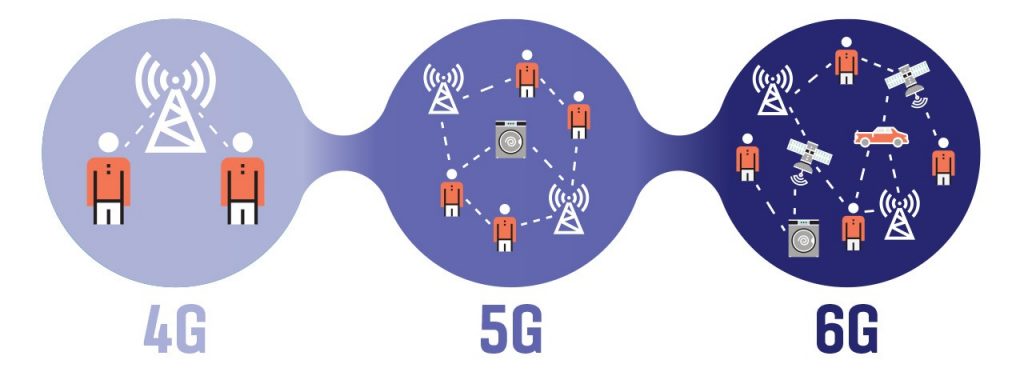
India is in the early stages of 6G development, with commercial deployment expected around 2030, aligning with global timelines. The Bharat 6G Vision, unveiled by Prime Minister Narendra Modi, outlines India’s ambition to lead in 6G technology, targeting at least 10% of global 6G patents by 2030. However, 6G is still in the research phase globally, with standardization efforts starting in 2023–2026 and evaluations planned for 2028. India’s 6G efforts focus on leveraging its 5G infrastructure, with upgrades planned to ensure compatibility with future 6G standards. The International Telecommunication Union (ITU) has supported India’s call for ubiquitous 6G coverage, aiming for affordable connectivity in rural and remote areas.
Native Research and Deployment in 6G
India is actively fostering indigenous 6G research through the Bharat 6G Vision, emphasizing collaboration between academia, industry, and government. Key initiatives include:
  • Research Partnerships: Jio Platforms has partnered with Finland’s University of Oulu for 6G research and standardization. Ericsson collaborates with IIT Madras’s Centre for Responsible AI (CeRAI) to align with India’s 6G goals.
  • Indigenous Standards: The success of the 5Gi standard, merged with global 5G standards by 3GPP, demonstrates India’s growing influence in global telecom standards.
  • Talent and Ecosystem Development: India is investing in state-of-the-art research facilities, incentives for startups, and talent development to build a robust 6G ecosystem. However, funding remains a challenge, with India’s FY25 telecom R&D budget at ₹1,100 crore (0.03% of GDP), significantly lower than China’s $1.55 trillion allocation. Experts suggest tapping into the ₹83,468 crore Universal Services Obligation Fund (USOF) to boost 6G research.
India’s Potential to Export 6G to the US, Europe, and Africa
India’s ability to export 6G technology depends on its success in R&D, patent acquisition, and infrastructure readiness. Here’s an analysis for each market:
  • United States:
    • Feasibility: India’s ambition to secure 10% of 6G patents and its collaboration with the US through initiatives like iCET (Initiative on Critical and Emerging Technologies) signal potential for technology partnerships. However, the US is investing heavily in 6G (e.g., $2.5 billion with Japan) and has its own Next G Alliance, making it a competitive market. India’s lack of significant 6G patent filings as of 2021 and reliance on foreign equipment could limit its export potential.
    • Timeline: Exporting 6G to the US by 2030 is unlikely due to the US’s advanced domestic efforts and security concerns over foreign tech (e.g., bans on Huawei). India might contribute niche solutions or software by 2035, provided it ramps up IP development and aligns with US standards.
  • Europe:
    • Feasibility: Europe lags in 5G deployment compared to India and China, with only 45% mid-band coverage by 2024. India’s cost-effective manufacturing and software expertise could position it to supply 6G solutions, especially if it aligns with European standards via 3GPP. However, Europe’s preference for Nokia and Ericsson and concerns over non-European suppliers may pose barriers.
    • Timeline: India could potentially export 6G components or software to Europe by 2032–2035, leveraging its growing influence in global standards and partnerships with European institutions like the University of Oulu.
  • Africa:
    • Feasibility: Africa has low 5G penetration (10–15% mid-band coverage by 2024), making it a promising market for affordable 6G solutions. India’s experience with 5Gi for rural coverage and its focus on cost-sensitive markets align well with Africa’s needs. India’s telecom giants like Jio and Airtel could partner with African operators to deploy 6G, especially with ITU’s support for affordable connectivity.
    • Timeline: India is well-positioned to export 6G technology to Africa by 2030–2032, potentially earlier than to the US or Europe, due to less competition and alignment with Africa’s connectivity goals.
Challenges and Outlook
India’s 6G ambitions face significant hurdles, including:
  • Funding: The modest R&D budget compared to China and the US limits India’s ability to compete in patent filings and infrastructure upgrades.
  • Infrastructure: Upgrading existing 4G/5G networks for 6G requires substantial investment, with high operational costs for energy and maintenance.
  • Global Competition: China’s lead in 6G patents and early satellite tests (e.g., the 2020 6G satellite launch) and the US’s strategic alliances pose challenges.
Despite these, India’s strengths in software, affordable manufacturing, and global partnerships position it as a potential 6G leader. Achieving 10% of global patents and leveraging initiatives like iCET could enable India to export niche 6G technologies (e.g., AI-driven network optimization) to markets like Africa by 2030–2032, with Europe following by 2032–2035. The US market, however, may remain challenging due to its advanced domestic efforts and security policies, with exports unlikely before 2035.
Summary Timeline:
  • Africa: 2030–2032
  • Europe: 2032–2035
  • US: 2035 or later
India’s success hinges on increased R&D funding, global standardization contributions, and strategic partnerships to overcome infrastructure and competitive challenges.
Monday, May 26, 2025

26: Super Agents

Trump Condemns Putin’s Killings in Ukraine, but Doesn’t Make Him Pay a Price President Trump says that the Russian president has “gone absolutely CRAZY’’ with attacks in Ukraine, but has so far refused to join Europe with its newest sanctions.

26: AOC

AOC edges out Chuck Schumer by double-digit margin in new poll

Rethinking Trade: A Blueprint for a Just and Thriving Global Economy
The $500 Billion Pivot: How the India-US Alliance Can Reshape Global Trade
Trump’s Trade War
Peace For Taiwan Is Possible
Formula For Peace In Ukraine
The Last Age of War, The First Age of Peace: Lord Kalki, Prophecies, and the Path to Global Redemption
AOC 2028: : The Future of American Progressivism

Rethinking Trade: A Blueprint for a Just and Thriving Global Economy
The $500 Billion Pivot: How the India-US Alliance Can Reshape Global Trade
Trump’s Trade War
Peace For Taiwan Is Possible
Formula For Peace In Ukraine
The Last Age of War, The First Age of Peace: Lord Kalki, Prophecies, and the Path to Global Redemption
AOC 2028: : The Future of American Progressivism

Rethinking Trade: A Blueprint for a Just and Thriving Global Economy
The $500 Billion Pivot: How the India-US Alliance Can Reshape Global Trade
Trump’s Trade War
Peace For Taiwan Is Possible
Formula For Peace In Ukraine
The Last Age of War, The First Age of Peace: Lord Kalki, Prophecies, and the Path to Global Redemption
AOC 2028: : The Future of American Progressivism

Rethinking Trade: A Blueprint for a Just and Thriving Global Economy
The $500 Billion Pivot: How the India-US Alliance Can Reshape Global Trade
Trump’s Trade War
Peace For Taiwan Is Possible
Formula For Peace In Ukraine
The Last Age of War, The First Age of Peace: Lord Kalki, Prophecies, and the Path to Global Redemption
AOC 2028: : The Future of American Progressivism

Velocity Money: Crypto, Karma, and the End of Traditional Economics
The Next Decade of Biotech: Convergence, Innovation, and Transformation
Beyond Motion: How Robots Will Redefine The Art Of Movement
ChatGPT For Business: A Workbook
Becoming an AI-First Organization
Quantum Computing: Applications And Implications
Challenges In AI Safety
AI-Era Social Network: Reimagined for Truth, Trust & Transformation

Velocity Money: Crypto, Karma, and the End of Traditional Economics
The Next Decade of Biotech: Convergence, Innovation, and Transformation
Beyond Motion: How Robots Will Redefine The Art Of Movement
ChatGPT For Business: A Workbook
Becoming an AI-First Organization
Quantum Computing: Applications And Implications
Challenges In AI Safety
AI-Era Social Network: Reimagined for Truth, Trust & Transformation

Velocity Money: Crypto, Karma, and the End of Traditional Economics
The Next Decade of Biotech: Convergence, Innovation, and Transformation
Beyond Motion: How Robots Will Redefine The Art Of Movement
ChatGPT For Business: A Workbook
Becoming an AI-First Organization
Quantum Computing: Applications And Implications
Challenges In AI Safety
AI-Era Social Network: Reimagined for Truth, Trust & Transformation

Velocity Money: Crypto, Karma, and the End of Traditional Economics
The Next Decade of Biotech: Convergence, Innovation, and Transformation
Beyond Motion: How Robots Will Redefine The Art Of Movement
ChatGPT For Business: A Workbook
Becoming an AI-First Organization
Quantum Computing: Applications And Implications
Challenges In AI Safety
AI-Era Social Network: Reimagined for Truth, Trust & Transformation

Velocity Money: Crypto, Karma, and the End of Traditional Economics
The Next Decade of Biotech: Convergence, Innovation, and Transformation
Beyond Motion: How Robots Will Redefine The Art Of Movement
ChatGPT For Business: A Workbook
Becoming an AI-First Organization
Quantum Computing: Applications And Implications
Challenges In AI Safety
AI-Era Social Network: Reimagined for Truth, Trust & Transformation

Velocity Money: Crypto, Karma, and the End of Traditional Economics
The Next Decade of Biotech: Convergence, Innovation, and Transformation
Beyond Motion: How Robots Will Redefine The Art Of Movement
ChatGPT For Business: A Workbook
Becoming an AI-First Organization
Quantum Computing: Applications And Implications
Challenges In AI Safety
AI-Era Social Network: Reimagined for Truth, Trust & Transformation

Velocity Money: Crypto, Karma, and the End of Traditional Economics
The Next Decade of Biotech: Convergence, Innovation, and Transformation
Beyond Motion: How Robots Will Redefine The Art Of Movement
ChatGPT For Business: A Workbook
Becoming an AI-First Organization
Quantum Computing: Applications And Implications
Challenges In AI Safety
AI-Era Social Network: Reimagined for Truth, Trust & Transformation

Germany greenlights use of NATO missile strikes 'deep into Russia'
How Trump's trade war is upending global economy
Trump warns attempts to conquer all of Ukraine will lead to ‘downfall’ of Russia
Trump tariffs threaten 370,000 jobs and $47 billion from Texas economy
‘Grounds for Impeachment’: Trump’s Downfall Predicted
Questions swirl as Tesla nears Austin launch day for high stakes driverless robotaxi launch

Velocity Money: Crypto, Karma, and the End of Traditional Economics
The Next Decade of Biotech: Convergence, Innovation, and Transformation
Beyond Motion: How Robots Will Redefine The Art Of Movement
ChatGPT For Business: A Workbook
Becoming an AI-First Organization
Quantum Computing: Applications And Implications
Challenges In AI Safety
AI-Era Social Network: Reimagined for Truth, Trust & Transformation

Velocity Money: Crypto, Karma, and the End of Traditional Economics
The Next Decade of Biotech: Convergence, Innovation, and Transformation
Beyond Motion: How Robots Will Redefine The Art Of Movement
ChatGPT For Business: A Workbook
Becoming an AI-First Organization
Quantum Computing: Applications And Implications
Challenges In AI Safety
AI-Era Social Network: Reimagined for Truth, Trust & Transformation

Software Ate the World. Now AI Is Eating Software.


Software Ate the World. Now AI Is Eating Software.

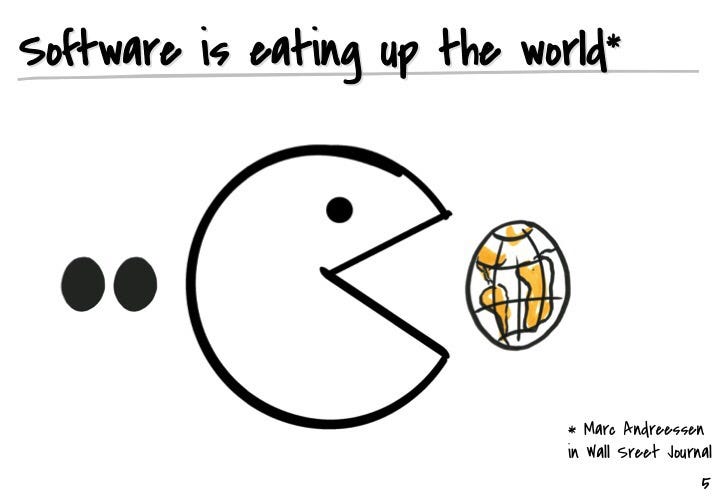
In 2011, Marc Andreessen famously declared that “software is eating the world.” And he was right. Over the next decade, nearly every industry was digitized, disrupted, or demolished by software. From how we shop to how we bank, from how we communicate to how we date, software became the invisible infrastructure of modern life. Every company became, in part, a software company.

But something new is happening now.

AI is eating software.

The New Eater Emerges

Artificial Intelligence, particularly large language models (LLMs), generative AI, and autonomous agents, are transforming how software is built, deployed, and even conceptualized. AI isn’t just another software tool—it’s a new layer that sits above software development itself.

Where once humans wrote code, now AI can generate it. Where once we had to meticulously design workflows, AI can infer and optimize them in real-time. AI doesn’t just use software—it writes, fixes, tests, and even replaces it.

From Apps to Agents

Apps used to be the endpoint of software innovation. You needed a team of developers to build a new productivity app, or a customer support system, or a recommendation engine. Now, an LLM can spin up an AI agent that handles all of that, learning as it goes.

Instead of building a CRM, businesses are deploying AI agents that are the CRM—automatically conversing with clients, managing data, summarizing interactions, and improving with every customer touchpoint.

We’re moving from a world of static software products to dynamic, self-improving, conversational systems.

Zero UI, Zero Code, Infinite Potential

AI is beginning to erode the traditional interfaces of software. Why click buttons and navigate menus when you can just say what you want?

Want a new dashboard? Tell your AI agent.

Need an email campaign launched, a spreadsheet analyzed, a bug fixed? Just describe the problem in plain English.

In this world, the real power isn’t in knowing how to code—it’s in knowing how to communicate. Prompting is the new programming. And anyone can prompt.

Implications: The Developer's Role Evolves

Developers are not becoming obsolete—they are becoming conductors rather than technicians. AI handles the repetitive, boilerplate code. Developers steer, architect, and integrate. More focus shifts to system design, governance, ethics, and human-AI collaboration.

Meanwhile, millions who were previously excluded from software creation now have tools to build, automate, and create at the speed of thought.

Beyond Software: Eating the World, Again

If software ate the world by digitizing it, AI is now reimagining it. AI is poised to redefine what’s possible in medicine, education, law, entertainment, science, and even governance.

It’s not just eating software—it’s reshaping intelligence itself.


Conclusion:

Software once transformed industries. Now AI is transforming software.

We’re not witnessing an incremental shift—we’re witnessing a recursive one: intelligence building intelligence, software creating software, and ideas becoming products without the friction of traditional development.

It’s not the end of software.

It’s the beginning of something much bigger.

The frontier tech prisoners dilemma

Beyond Silicon Valley: 20 Global Tech Innovation Hubs Shaping the Future


Beyond Silicon Valley: 20 Global Tech Innovation Hubs Shaping the Future

Silicon Valley has long reigned as the epicenter of global tech innovation. But the 21st century is ushering in a new era of decentralization. The rise of digital tools, remote work, AI, and globally connected talent has fueled the growth of tech hubs around the world. Today, the next unicorn or game-changing innovation could emerge from Nairobi as easily as from San Jose.

Here are 20 global innovation hubs beyond Silicon Valley that are shaping the tech-driven future:


1. Shenzhen, ChinaThe Hardware Capital of the World

From consumer electronics to robotics, Shenzhen is unmatched in hardware prototyping and mass production. It’s where hardware dreams become physical realities at lightning speed.


2. Bengaluru, IndiaIndia’s Silicon Valley

A vibrant mix of startups, global R&D centers, and deep technical talent, Bengaluru is a hub for SaaS, fintech, AI, and deep tech. It’s the engine of India’s digital transformation.


3. Tel Aviv, IsraelStartup Nation

Israel has the highest number of startups per capita. Tel Aviv shines in cybersecurity, health tech, agritech, and deep tech innovation, often backed by elite military R&D.


4. London, UKFintech and AI Powerhouse

London remains Europe’s tech and finance capital. It leads in fintech, regtech, AI ethics, and creative tech, with strong access to capital and global markets.


5. Berlin, GermanyCreative and Startup Magnet

Berlin blends artistic culture with a vibrant startup ecosystem. It’s a haven for entrepreneurs building in e-commerce, green tech, mobility, and Web3.


6. Toronto, CanadaAI and Research Excellence

Fueled by world-class universities and immigration-friendly policies, Toronto is emerging as an AI research capital, home to DeepMind, Cohere, and many generative AI startups.


7. SingaporeSmart Nation in the Making

Singapore is a hub for fintech, urban innovation, and logistics tech. With strong government support and Southeast Asia access, it’s ideal for regional HQs.


8. Stockholm, SwedenHome of the Scalable Startup

Spotify, Klarna, and Skype were born here. Stockholm has a high rate of billion-dollar startups per capita, focused on design, fintech, and sustainability.


9. Seoul, South KoreaConsumer Tech and 5G Pioneer

Backed by giants like Samsung and LG, Seoul is a leader in consumer electronics, AI chips, robotics, and 5G infrastructure.


10. Paris, FranceAI and Deep Tech Hub

France’s investments in AI and quantum computing are drawing global attention. Paris is rising as a European hub for health tech, robotics, and space tech.


11. São Paulo, BrazilLatin America’s Tech Titan

São Paulo anchors Latin America’s tech boom, especially in fintech, logistics, and edtech. Nubank and iFood are examples of local unicorns scaling globally.


12. Nairobi, KenyaAfrica’s Silicon Savannah

With innovations in mobile money (like M-Pesa), agritech, and civic tech, Nairobi is a launchpad for tech that meets real-world needs across Africa.


13. Ho Chi Minh City, VietnamRising Tech Tiger

Vietnam is gaining ground in software services, blockchain, and AI, with a young, digitally savvy workforce and growing VC interest.


14. Dubai, UAEGovernment-Backed Innovation Lab

Dubai blends regulatory experimentation with bold visions—crypto, AI courts, flying taxis. It’s positioning itself as the tech capital of the Middle East.


15. Austin, USAThe American Alternative

Known for its “Silicon Hills,” Austin is a U.S. tech magnet with a booming startup scene, especially in AI, enterprise SaaS, and electric vehicles.


16. Tallinn, EstoniaDigital Governance Leader

Estonia’s e-residency and digital-first government have made Tallinn a model of digital innovation in public services and startup friendliness.


17. Beijing, ChinaAI and Quantum Giant

With strong state support, Beijing is at the forefront of AI, quantum research, and smart city development. It’s a tech policy powerhouse.


18. Istanbul, TurkeyGateway to Three Continents

Istanbul is seeing rapid growth in mobile gaming, fintech, and e-commerce, serving as a regional hub between Europe, Asia, and the Middle East.


19. Lagos, NigeriaWest Africa’s Innovation Engine

Nigeria’s digital economy is booming with fintech like Flutterwave and Paystack. Lagos is a dynamic hub with a growing youth-driven tech sector.


20. Barcelona, SpainDesign-Driven Tech and Mobility Hub

Barcelona merges creativity with urban innovation, smart mobility, and cleantech. It’s also a top destination for tech nomads and Web3 startups.


Conclusion:

While Silicon Valley remains unmatched in legacy and scale, the future of innovation is global. Each of these hubs brings unique strengths—from mobile money in Africa to AI in Canada, hardware in China, and public digital infrastructure in Estonia.

The next big thing could be built anywhere. And that’s exactly what makes this moment in tech history so exciting.


What other cities do you think belong on this list? Drop them in the comments below or tweet at us @paramendra