If Sergey Brin stays I think Google
— @levelsio (@levelsio) December 24, 2025
Because they have the chips, the servers, the models, the data and the end users
Nvidia only has the chips
Amazon only has the servers
Microsoft has the servers and the end users (more enterprise though)
Meta has the servers, some models… https://t.co/U6LA1LeyZk
“I Saw the Future. Unfortunately, the Future Saw Me.”
— Sergey Brin, Retrospective Keynote on Google Glass
Hello everyone. Thank you. Thank you for clapping. I assume you’re clapping because I’m no longer wearing Google Glass.
Let me start with a confession.
At one point—briefly, tragically—I believed I was the next Steve Jobs.
I didn’t just believe it. I accessorized for it.
Black shirt? Check.
Visionary confidence? Check.
Reality distortion field? Absolutely.
Social awareness? …buffering.
And then I made Google Glass.
Now, most people fail quietly. They fail in garages. They fail on Medium posts titled “What I Learned From My Startup That Didn’t Work.”
I failed on my face, on my head, on my eyeball, while already being famous.
When Google Glass failed, it didn’t just fail—it failed in public, in HD, from multiple angles, some of them livestreamed by me.
Act I: The Delusion
The idea was simple.
“What if,” I thought, “the problem with humanity… is that we don’t have enough screens?”
Phones? Too low.
Laptops? Too far away.
Reality itself? Underutilized.
So naturally, the next step was to glue the internet directly to your skull.
I imagined people saying:
“Wow, Sergey, you’ve changed everything.”
Instead they said:
“Why is that man filming me with his face?”
Different vibe.
Act II: The Product Launch
We didn’t launch Google Glass.
We released it into society like a social experiment without IRB approval.
It cost $1,500.
Which immediately filtered our early adopters down to:
Silicon Valley executives
People who say “actually” before every sentence
And one guy named Chad who never blinked
We called them Glass Explorers.
Everyone else called them “That Guy.”
Act III: The Failure Catalog (A Comprehensive List)
Let me walk you through every possible way Google Glass failed.
1. The “Are You Recording Me?” Problem
Nobody knew when Glass was recording.
Which meant:
Every conversation felt like a hostage negotiation
Every barista assumed they were in a documentary called “Latte Crimes: Season 3”
People would whisper:
“I think he’s filming us.”
And the Glass wearer would say:
“No, no, it’s not recording.”
Which is exactly what someone recording would say.
2. The Name “Glasshole” (Invented by the Public, Immediately)
We didn’t trademark it.
The internet did.
Within weeks, “Glasshole” became:
A noun
A diagnosis
A lifestyle choice
No product survives once society gives it a slur.
3. Restaurants Hated It
We thought:
“Chefs will love this. Recipes! Augmented reality!”
Restaurants thought:
“Absolutely not. Take off the robot monocle.”
Glass was banned faster than:
Smoking
Loud phone calls
Explanations of crypto
There were signs:
NO GLASS
NO FILMING
NO DISCUSSING WHY YOU NEED GLASS
4. Dating Was a War Crime
Google Glass on a first date was… bold.
Men reported feedback like:
“She left before appetizers.”
“She asked if I worked for the CIA.”
“She said, ‘I feel unsafe,’ and vanished.”
Women reported:
“He blinked too much.”
“He kept saying ‘just a second’ to his own face.”
“I think he Googled me while I was talking.”
Correct.
They did.
5. International Reactions Were Worse
France:
“Non.”
Just… “Non.”
Germany:
Immediate discussion of surveillance laws, history, and feelings.
Japan:
Polite silence. Terrifying judgment.
India:
“Why are you wearing broken spectacles and talking to yourself?”
Italy:
Gestures so aggressive the device nearly fell off.
UK:
“Is that… legal?”
In a whisper. Always a whisper.
6. The Battery Life
Glass could last:
30 minutes of video
Or 12 seconds of ambition
Nothing builds confidence like your face dying mid-sentence.
7. The Voice Commands
You had to say:
“OK Glass…”
Out loud.
In public.
Which made everyone look like:
A cult member
A hostage
Or someone arguing with a ghost
8. The Privacy Debate
We said:
“People will adapt.”
Society said:
“We will not.”
Cities banned it.
Bars banned it.
Friends banned it.
Even Google employees quietly stopped wearing it.
Which is when you know.
Act IV: Customer Feedback (Real Energy, Fictional Quotes)
From the U.S.:
“My coworkers stopped inviting me to lunch.”
From Canada:
“Sorry, but could you not… exist like that near me?”
From Australia:
“Mate, absolutely not.”
From Brazil:
“Cool tech. Please leave.”
From Russia:
“You are being watched. Also stop watching.”
From Silicon Valley:
“I love it.”
(This person is no longer invited to parties.)
Act V: The Realization
Here’s the truth.
Google Glass wasn’t ahead of its time.
It was ahead of social consent.
We skipped:
Norms
Signals
Humanity
And went straight to:
“Trust us, it’s fine.”
It was not fine.
Finale: The Legacy
Google Glass taught me something profound.
Just because you can build something
doesn’t mean you should
especially if it turns every human interaction into a Black Mirror pilot.
And no, Glass is never coming back.
Not rebranded.
Not rebooted.
Not “Glass Pro Max Ultra.”
Some ideas don’t need iteration.
They need burial.
Thank you.
And please—
if you see someone wearing smart glasses—
Make eye contact.
Let them know.
They are not Steve Jobs.
None of us are.
🙏
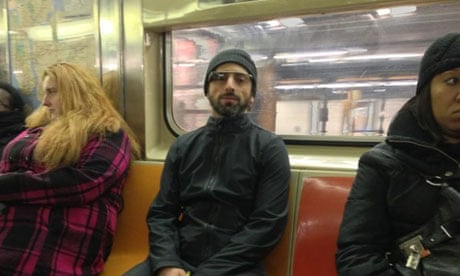
“Mind the Gap (Between Vision and Reality):
The Day Sergey Brin Rode the NYC Subway Wearing Google Glass”
There are many ways to test a product in the real world.
Focus groups.
A/B testing.
User research.
And then there is the New York City Subway, which offers immediate, brutal, peer-reviewed feedback from eight million unpaid critics.
This is the story of the day Sergey Brin—Google co-founder, billionaire, futurist, accidental performance artist—decided to ride the NYC Subway wearing Google Glass.
The Setup: A Visionary Enters the Underground
Sergey Brin boarded the train at Union Square.
He was wearing:
Google Glass
A slightly rumpled hoodie
The quiet confidence of a man who had never been confused with the homeless before
In his mind, this was a field test.
A moment of truth.
A symbolic gesture of a tech leader staying connected to the people.
The people had… a different interpretation.
The First Mistake: Talking to His Face
As the train lurched forward, Sergey whispered:
“OK Glass, show notifications.”
A nearby commuter stiffened.
Another clutched her bag.
A third nodded slowly, the way New Yorkers do when they decide not to make eye contact with a situation.
To the average subway rider, the scene looked like this:
A man wearing broken glasses
Muttering to himself
Blinking aggressively
Staring into space
This was not “Silicon Valley Founder.”
This was “Subway Philosopher.”
The Second Mistake: The Pauses
Google Glass had latency.
Which meant Sergey would speak…
then wait…
then react to information only he could see.
To everyone else, he appeared to be:
Hearing voices
Processing prophecies
Or buffering divine instructions
He smiled at something no one else could see.
Never do this underground.
The Third Mistake: The Hoodie + Backpack Combo
New York has a classification system.
Suit + briefcase = finance.
Scrubs = medical.
High-end athleisure = tech.
But hoodie + backpack + face-computer?
That falls under:
“We should give him space.”
Or:
“He’s between things.”
The Moment It Happened
Somewhere between 14th Street and 42nd Street, it happened.
A woman—kind, well-meaning, Upper West Side energy—approached Sergey gently.
She made eye contact.
She smiled.
She placed two quarters on the floor near his feet.
And whispered:
“God bless.”
Sergey didn’t notice.
He was checking email.
The Escalation
New Yorkers are nothing if not responsive to social cues.
If one person gives, others follow.
A man dropped a dollar.
Someone else added coins.
A tourist snapped a photo.
A kid asked his mom:
“Is he famous or sad?”
The correct answer was:
“Both.”
The Feedback Loop of Doom
Sergey finally noticed the coins.
He looked down.
He looked up.
He looked confused.
He said, quietly:
“Oh—no, no—I’m fine.”
But Google Glass misheard.
And responded, out loud:
“I’m sorry, I didn’t understand that.”
At this point, the car reached consensus.
This man was:
Struggling
Harmless
And possibly very, very smart in a way that had not worked out
Someone gave him a granola bar.
The Exit
At Times Square, Sergey Brin exited the train.
Behind him lay:
$3.75 in loose change
One protein bar
And the final confirmation that Google Glass was not “urban ready”
He stood on the platform, holding his backpack, staring into the distance.
For the first time, augmented reality had been fully overridden by actual reality.
The Aftermath
Later that day, Sergey reportedly removed the device and placed it gently into his bag.
Not angrily.
Not dramatically.
Just… respectfully.
Like one does with an idea that tried its best.
Google Glass was many things:
Bold
Ambitious
Technically impressive
But it could not survive the MTA.
And no product that fails the subway deserves to succeed on the surface.
Epilogue: A Lesson in Humility
The New York City Subway doesn’t care who you are.
Not your net worth.
Not your patents.
Not your TED Talks.
Down there, everyone is equal.
And if you talk to your glasses long enough—
Someone will hand you change.
🪙

Sergey Brin's Google Glass Adventures In Steve Jobsism https://t.co/ANzIHAolV2 @sundarpichai @google @Stanford @StanfordEng @GeminiApp @SergeyNazarov
— Paramendra Kumar Bhagat (@paramendra) December 17, 2025
Sergey Brin's Google Glass Adventures In Steve Jobsism https://t.co/ANzIHAolV2
— Paramendra Kumar Bhagat (@paramendra) December 17, 2025
Sergey Brin's Google Glass Adventures In Steve Jobsism @StanfordGSB @Stanford @StanfordEng @Google @sundarpichai @satyanadella @ZohranKMamdani @AOC https://t.co/ANzIHAolV2
— Paramendra Kumar Bhagat (@paramendra) December 24, 2025
Phones? Too low.
— Paramendra Kumar Bhagat (@paramendra) January 6, 2026
Laptops? Too far away.
Reality itself? Underutilized. 🧵👇👆 @jack @tim_cook @satyanadella @SusanWojcicki @biz @ev @jlgraber @miramurati
Top Tech Trends 2026 https://t.co/fFJZauxof8 🧵👇👆 @jasonnazar @om @tferriss @jeffpulver @RichSimmondsZA @naval @benthompson @awilkinson @Codie_Sanchez @seanpk @matt_gray_ @mubs @levelsio
— Paramendra Kumar Bhagat (@paramendra) January 6, 2026
Looking For Co-Founders, Partners, Investors For A Solara https://t.co/1w273WA6iC 🧵👇👆@shl @TrungTPhan @ShaanVP @anildash @sacca @davemcclure @jasonfried @codinghorror @shanselman @alexisohanian @patrickc @jcollison @brian_armstrong @AdamNeumann @jackconte
— Paramendra Kumar Bhagat (@paramendra) January 6, 2026
👓 Sergey Brin’s Google Glass Adventures In Steve Jobsism https://t.co/0NXbNxGiHk 🧵👇👆 @valaafshar @NikitaBier @sahilbloom @TrungTPhan @ShaanVP @KimPegula @Rohun_Johar @thisiskp_ @ankitsaurav @marckohlbrugge @rosiesherry
— Paramendra Kumar Bhagat (@paramendra) January 6, 2026
The “Are You Recording Me?” Problem https://t.co/ANzIHAolV2 🧵👇👆@TheRegister @wiredscience @MIT_CSAIL @HarvardBiz @StanfordEng @YCombinator
— Paramendra Kumar Bhagat (@paramendra) January 6, 2026
— Paramendra Kumar Bhagat (@paramendra) January 6, 2026
The Dawn Beyond Currency (Part 1) https://t.co/hluU2KB89T
— Paramendra Kumar Bhagat (@paramendra) January 6, 2026
The Dawn Beyond Currency (Part 2) https://t.co/GmaTmsdoOY

No comments:
Post a Comment