Pages

Showing posts with label metaverse. Show all posts

Saturday, November 08, 2025

VR, Metaverse: Lighter, More Human Words That Evoke Presence, Play, Emotion, And Connection Rather Than Jargon


Excellent insight. VR, metaverse, spatial, and worlds have all grown stale or overhyped. They sound either too technical or too “Web3-bubble.” What’s needed now are lighter, more human words that evoke presence, play, emotion, and connection rather than jargon.

Here’s a creative taxonomy of fresh, marketable substitutes — depending on tone and audience.


๐ŸŒฌ️ 1. Soft & Human-Centered Alternatives

Use these if your brand wants to sound friendly, accessible, and emotionally engaging.

Old Term Better Substitute Notes
VR Immersive view, living lens, dreamspace Suggests emotion & perception instead of tech.
Metaverse the Flow, the Loop, the Commons, the Layer, the Canvas Evokes social, creative, and open systems.
Spatial felt space, living room, flow zone, presence field Humanizes the sense of shared proximity.
Worlds realms, stories, loops, lands, fields, dreamscapes Feels poetic and open-ended.

2. Trendy, Tech-Lite Terms

Great for startups, creators, or apps blending AI + immersion.

Concept Fresh Phrase Rationale
Virtual environments experience pods, presence hubs, shared flow, story layers Sounds futuristic but friendly.
Metaverse platforms living internet, next web, presence net, flow web Avoids hype; suggests evolution, not revolution.
3D or immersive media holo media, living content, deep media, flowcasts Light, catchy, and intuitive.

๐ŸŒฑ 3. Natural & Organic Language

Evokes warmth, nature, and life—ideal for mainstream adoption.

Old Jargon New Word Emotional Anchor
VR headset viewband, senseband, dreamvisor Gentle, wearable, sensory.
Metaverse app playfield, garden, grove, commons Implies human gathering & growth.
Spatial computing living interface, field sense, reality mesh Feels intuitive and grounded.

๐Ÿ”ฎ 4. Premium & Visionary Vocabulary

For high-concept storytelling or visionary tech brands.

Old Term New Substitute Feel
Metaverse Continuum, Living Web, Dimension X, The Fold, The Loom Evokes scale and sophistication.
Spatial Computing Cognitive Canvas, Reality Cloud, The Layer Suggests intelligence and synthesis.
Virtual World Parallel Space, Dream Layer, Reality Stream Feels cinematic and fluid.

๐Ÿง  5. Single-Word Brandable Concepts

Coinable or brand-ready words that could trend:

  • Flowverse – soft evolution of “metaverse”

  • Dreamnet – poetic, memorable

  • Realspace – grounding alternative to “virtual space”

  • Sensefield – evokes presence and connection

  • The Loop – simple, sticky, social

  • FlowOS – for a platform or ecosystem

  • The Layer – modular, tech-chic, minimal

  • Presence Cloud – enterprise-credible, human-friendly

  • Holohood – playful, communal, youthful

  • Dreamline – implies narrative continuity and vision


Brand Naming & Messaging Guide for the Post-Metaverse Era — a toolkit for startups, storytellers, or platforms that want to sound fresh, human, and visionary without falling into the VR/Metaverse jargon trap.


๐Ÿงญ PART I — The New Language of Presence

Forget metaverse and VR. The future isn’t about escaping reality — it’s about expanding it. The new lexicon must feel alive, sensory, emotional, and social.

Core Idea New Lexicon Tone & Feel
Virtual Reality Living Reality, Immersive View, Flowspace Organic and human.
Metaverse The Loop, The Flow, The Continuum, The Layer Social and interconnected.
Spatial Computing Reality Mesh, Presence Cloud, Living Interface Intelligent and intuitive.
Virtual Worlds Playfields, Dreamlands, Commons, Story Realms Creative and social.

๐ŸŒŠ PART II — Three Brand Archetypes for This Era

Every product or campaign can anchor in one of these new marketing archetypes. Each archetype includes tone, vocabulary, and tagline direction.

1. The Flow ArchetypeFluid, Emotional, Effortless

Keywords: flow, stream, current, loop, wave, drift
Tone: poetic, relaxed, human, natural
Sample Brand Names:

  • FlowOS

  • Sensefield

  • Driftspace

  • The Loop

  • Fluid

Sample Taglines:

  • “Step into the Flow.”

  • “Reality, just lighter.”

  • “Where ideas drift and connect.”

  • “The Loop never ends—join it.”


2. The Dream ArchetypePlayful, Creative, Emotional

Keywords: dream, story, sky, field, horizon, canvas
Tone: imaginative, youthful, warm
Sample Brand Names:

  • Dreamline

  • Skyfield

  • StoryLayer

  • CloudCanvas

  • Horizon OS

Sample Taglines:

  • “Paint your world in real time.”

  • “Dream it. Live it. Share it.”

  • “Reality, rewritten in color.”

  • “A new layer of imagination.”


3. The Presence ArchetypeReal, Grounded, Connected

Keywords: sense, field, commons, mesh, circle, link
Tone: communal, earthy, grounded, tech-light
Sample Brand Names:

  • Sensefield

  • Presence Cloud

  • The Commons

  • Realspace

  • Circl

Sample Taglines:

  • “Closer than ever.”

  • “Shared presence. Simple as breathing.”

  • “The web becomes a place again.”

  • “Reality, together.”


๐Ÿ”ฎ PART III — Naming Frameworks

A. One-Word Trendables

Light, rhythmic, easy to say, brandable:

  • Flowverse

  • Dreamnet

  • Realspace

  • SenseOS

  • Flowhood

  • The Layer

  • Holohood

  • Continuum

  • Loopline

B. Compound Word Names

Blend human + tech vocabulary:

  • Mindloop

  • Skyflow

  • Dreamfield

  • SenseCloud

  • RealityStream

  • Playmesh

  • LightField

C. Evocative Phrases (for Taglines / Campaigns)

  • “Reality with feeling.”

  • “The living web begins here.”

  • “Dream in layers.”

  • “Enter softly.”

  • “Built for human presence.”

  • “From screens to scenes.”

  • “The digital becomes breathable.”


๐ŸŒ PART IV — Positioning Language

Old Hype New Fresh Alternative Tone Shift
“Enter the metaverse.” “Join the Flow.” From hype → human.
“Virtual experiences.” “Shared moments.” From tech → emotion.
“Spatial computing.” “The living web.” From sterile → organic.
“Digital twins.” “Reality mirrors.” From jargon → poetic.
“3D avatars.” “Living selves.” From cartoon → presence.

๐Ÿงฉ PART V — Short Marketing Scripts

For a Product Launch

“We built Flowspace for creators who don’t want to log in — they want to step in.
Not a metaverse. Not another world. Just your world, more alive.”

For an Enterprise Pitch

“Presence Cloud turns digital work into human collaboration.
Meetings become moments, data becomes dialogue.”

For a Consumer App

“Dreamline is where stories live — not as videos, but as living memories you can walk through.”


๐ŸŒ  PART VI — Principles for the New Lexicon

  1. Drop the buzzwords.
    No “metaverse,” “blockchain,” or “VR” up front. Lead with the feeling of the experience.

  2. Use verbs of movement.
    Flow, drift, connect, breathe, loop, sense, unfold.
    Movement implies life and simplicity.

  3. Anchor in emotion, not engineering.
    Replace “compute,” “spatial,” or “render” with “feel,” “see,” or “share.”

  4. Think of nature as metaphor.
    Fields, rivers, clouds, gardens — familiar, universal, calming.
    It helps abstract tech feel organic.


๐Ÿชถ PART VII — 5 Example Product Ecosystems (Re-Imagined)

Product Type Old Name New Generation Branding
VR headset Meta Quest Flowband, Dreamvisor, Senseband
3D creative tool Unity / Unreal CanvasOS, StoryField
Collaboration platform Horizon Workrooms Presence Cloud, Flowspace
Social app Roblox / Zepeto The Commons, Loopline, Playfield
AI simulation engine Omniverse Reality Mesh, Cognitive Canvas


The Real Failure of VR: A Design Flaw Masquerading as a Marketing Problem

Why the Metaverse Never Landed—and How Human-Centered Design Can Still Save It


Introduction: When Innovation Meets Nausea

The problem with Virtual Reality was never just branding. It wasn’t the word “metaverse” or the corporate logos trying to trademark our collective imagination. The real problem was physiological, not philosophical.

VR failed because it made people sick. Literally.

The headsets promised escape, immersion, and limitless new worlds—but instead, they induced headaches, nausea, dizziness, and detachment. The “killer app” turned out to be motion sickness. In the end, it wasn’t the dystopian sci-fi fears that doomed the metaverse—it was our inner ear.

What was billed as the next internet became a lesson in the limits of human-centered design.


1. The Design Disconnect: Tech That Fought the Body

Every major technological leap has succeeded by aligning with how humans naturally see, move, and think.

  • The mouse mimicked the hand.

  • The touchscreen mimicked the fingertip.

  • The smartphone mimicked the pocket diary.

VR, however, demanded that we leave the body behind.

Headsets forced our eyes to focus on a screen a few centimeters away, while our brains were told we were running, flying, or floating. This war between eye and inner ear created dissonance—our neurons revolted. It wasn’t immersive; it was invasive.

A technology that aspired to dissolve the boundary between digital and physical instead deepened it. VR became a metaphor for disembodiment itself: humans dangling between two realities, feeling sick in both.


2. The False Promise of “Presence”

Marketers called it presence: the illusion of being somewhere else.
But presence without comfort is alienation.

The mistake wasn’t ambition—it was misunderstanding the medium. VR sought to replace reality rather than extend it. The metaverse builders imagined that people wanted to spend hours in artificial worlds, meeting coworkers as legless avatars, floating in fluorescent voids.

But humans don’t crave pixels—they crave place.
They don’t want to “escape” reality; they want to enrich it.

Presence isn’t about tricking the senses—it’s about heightening connection, clarity, and flow. The headset, instead of freeing people, became a blindfold.


3. The Human Ergonomics Revolution That Never Happened

There’s a reason we don’t walk around with ski goggles strapped to our faces for fun. The ergonomics of VR were a nonstarter. Heavy, sweaty, isolating—the experience violated the first law of interface design: “Do not make people suffer to use your product.”

Early VR evangelists compared it to the iPhone moment. But the iPhone wasn’t just powerful—it was beautiful, portable, and intuitive. It fit the palm; it disappeared into life.

VR, by contrast, required ritual and resistance: charge the headset, clear the room, calibrate the sensors, tighten the straps. It turned the simplest act—putting it on—into a barrier.

Good design disappears. VR screamed.


4. The “Metaverse” Mirage: Fixing Marketing, Ignoring Physics

When the public balked, Silicon Valley tried to rebrand the nausea away. Metaverse was supposed to be the new frontier—the internet evolved into experience.

But language couldn’t fix lag.
Slogans couldn’t stop vertigo.
No amount of marketing magic could mask the truth that the hardware and human physiology were still at odds.

It was the same hubris that has haunted many tech revolutions: believing that scale and storytelling can outrun the body’s limits. But biology always wins.

The failure wasn’t in selling the idea; it was in selling it before it was livable.


5. The Next Frontier: Designing for Comfort, Not Control

The lesson for the next generation of immersive technologies—whether we call them Flowspaces, Dreamfields, or Presence Clouds—is simple:

Design must serve the nervous system before it serves the network.

We need devices that harmonize with human rhythm—lightweight, eye-safe, socially transparent, emotionally intelligent. Interfaces that listen to the body rather than override it.

Emerging “micro-immersion” technologies, like spatial audio, holographic displays, or ambient AR layers, suggest a more humane path forward—augmenting reality, not replacing it. Instead of escape pods, think windows. Instead of simulation, think sensation.

The future won’t belong to the companies that build deeper worlds; it will belong to those that build softer thresholds between worlds.


6. The Way Forward: From Headsets to Heartsets

The new design philosophy of the coming era will be empathy-driven computing:

  • Devices that adjust brightness, tone, and scale to your emotional state.

  • Experiences that reduce strain rather than exploit attention.

  • Interfaces that feel like breathing, not bracing.

VR made us forget that the most advanced interface is still the human body—and the most immersive medium is still human emotion.

When people talk about the “post-metaverse” age, they’re really describing a return to human sense-making. We’re entering an age of presence without pain, of digital touch that feels natural, and worlds that don’t require headgear to feel real.


Conclusion: A New Kind of Reality

In hindsight, the metaverse was never too early—it was too heavy. The dream wasn’t wrong; the design was.

The problem wasn’t that people didn’t want immersion; it’s that they didn’t want migraine.

To build the next generation of presence tech, we must stop thinking like engineers and start thinking like anatomists, artists, and poets. Technology must fit the body before it can reshape the world.

When that happens—when comfort becomes the new innovation—the real metaverse, the one we were promised, may finally arrive.

And this time, we won’t need a headset to feel it.


Beyond the Headset: The Design Failure That Broke VR—and the Neuroergonomic Future That Can Save It

A Whitepaper on the Collapse of the Metaverse and the Rise of Human-Centered Reality Design


Executive Summary

Virtual Reality was supposed to be the next leap in human experience—a bridge between imagination and embodiment. Instead, it became a cautionary tale in overpromising and underfeeling.

The fall of the metaverse wasn’t merely a marketing failure; it was a design failure at the level of human biology. Headsets caused nausea, eyestrain, and alienation not because users were weak, but because the technology ignored the nervous system’s basic design parameters.

This whitepaper argues that the next generation of immersive technology must be guided not by rendering power but by neuroergonomic empathy—the science of designing systems in harmony with the brain and body. We explore:

  • The physiological roots of VR’s failure

  • The mismatch between machine design and sensory architecture

  • The psychological fallout of forced immersion

  • Emerging pathways toward Presence-Centered Design

  • Frameworks for Neuroergonomic Interfaces that align with human cognition, emotion, and perception

In short: the future of immersive technology is not “more virtual.” It is more human.


1. The Mirage of the Metaverse

In 2021, Silicon Valley rebranded itself around a dream—the metaverse. It promised to merge all realities: social, professional, artistic, and economic, into a seamless 3D web.

Investors poured billions into this “next internet,” but by 2025 the momentum had collapsed. Consumer adoption plateaued. Developers pivoted. Stock prices fell. And users, after a few minutes of experimentation, quietly removed their headsets and never put them back on.

The diagnosis was simple yet devastating: VR made people feel bad.

But that symptom masked a deeper cause—an entire industry that designed for fantasy, not physiology.


2. The Design Failure Beneath the Surface

2.1 The Physiology Problem

Humans evolved to navigate real space through synchronized sensory feedback loops.

  • Eyes track motion.

  • Inner ears (vestibular system) detect balance and acceleration.

  • Proprioception (muscle sense) confirms position in space.

In VR, these systems are forced out of sync. The eyes perceive motion while the body remains still, triggering sensory conflict, the root cause of motion sickness. This is not a minor UX flaw—it’s a neurological design incompatibility.

Diagram 1: Sensory Feedback Conflict

[Visual Motion] → Brain perceives forward movement
[Inner Ear (no motion)] → Brain perceives stillness
↓
Cognitive Dissonance → Dizziness, nausea, fatigue

2.2 The Ergonomic Oversight

Early headset design prioritized field of view, resolution, and refresh rate—metrics of machine fidelity, not human comfort. The result:

  • Excess weight on the neck and face

  • Eye convergence fatigue from stereoscopic misalignment

  • Heat accumulation and claustrophobia

  • Social isolation (blocked vision of physical space and people)

Diagram 2: Layers of Discomfort

[Physical Load] → Neck strain, heat
[Visual Load] → Eye strain, blur adaptation
[Cognitive Load] → Orientation confusion
[Social Load] → Isolation and self-consciousness

The irony: devices meant to create “presence” actually erased it.


3. The Psychology of Presence and the Illusion of Control

3.1 Presence Without Belonging

Presence—the feeling of “being there”—was VR’s holy grail. Yet real presence is not just sensory alignment; it’s psychological belonging.
People feel “present” not when pixels are sharp, but when purpose is clear and social context feels safe.

VR trapped users in beautifully rendered emptiness. Even multi-user spaces felt sterile: avatars without micro-expressions, environments without tactile reality. The brain knows when it’s faking connection.

3.2 The Cognitive Cost of Total Control

VR aimed for omnipotence—users could fly, teleport, reshape landscapes. But endless control creates decision fatigue.
Paradoxically, constraints create meaning. A chair that you can’t walk through, a horizon you can’t reach—these limitations anchor the self.

In VR, everything is editable; nothing feels real. The human mind finds comfort in friction.


4. Marketing Tried to Save It—But the Body Said No

The “metaverse” narrative was an attempt to rebrand discomfort as destiny. But semantic gloss couldn’t hide somatic truth.

Language like “worlds,” “realities,” and “spatial computing” failed because the experience itself was not livable. When the act of entering a space feels like donning scuba gear for your brain, no slogan can fix it.

Diagram 3: The Reality Gap

[Brand Promise] → “Limitless, connected, immersive”
[User Reality]  → “Heavy, isolating, disorienting”
↓
Trust Collapse → Brand rejection

5. From “Virtual Reality” to “Vital Reality”

To move forward, we must invert the paradigm.
Instead of simulating reality, technology must support vitality—the felt sense of being alive and attuned.

We propose a new framework: Presence Design Principles (PDP)


6. Presence Design Principles (PDP)

6.1 Principle 1: Harmonize with the Senses

Design should align with natural perception, not fight it.

  • Use light field displays instead of stereoscopic split screens.

  • Integrate subtle motion cues synchronized with vestibular input.

  • Favor wide peripheral awareness over tunnel vision.

Goal: The user forgets the interface, not their body.


6.2 Principle 2: Design for Comfort Before Control

Control is power; comfort is peace.

  • Prioritize ergonomic wearability and passive cooling.

  • Limit session length based on cognitive strain thresholds.

  • Design gestures that follow natural muscle memory (reach, grasp, turn).

Goal: Technology that feels like breathing.


6.3 Principle 3: Create Shared Anchors

Presence is amplified by shared meaning.

  • Use anchored audio-visual references that connect users to common spatial cues.

  • Blend digital and physical props (haptic tables, real lighting).

  • Design social presence indicators—eye gaze, micro-delays, breathing rhythms.

Goal: Social resonance, not simulation.


6.4 Principle 4: Preserve Psychological Safety

A sense of grounding prevents dissociation.

  • Always provide “exit anchors”—visible or tactile cues to the physical world.

  • Avoid over-stimulation or rapid motion.

  • Respect emotional consent in virtual social encounters.

Goal: Reality that expands without disorienting.


6.5 Principle 5: Build for Accessibility and Diversity

Not all brains perceive the same way.

  • Calibrate for neurodiverse comfort zones (sensitivity, motion thresholds).

  • Offer non-visual presence cues—audio, vibration, spatial sound.

  • Support variable immersion levels—from glanceable AR to deep focus.

Goal: Inclusive presence, not uniform illusion.


7. Neuroergonomic Interfaces: The Next Frontier

If VR failed because it ignored the body, Neuroergonomic Interfaces (NI) will succeed because they listen to it.

7.1 Definition

Neuroergonomic Interface: A system that adapts dynamically to the user’s cognitive, emotional, and physiological state, optimizing comfort and engagement in real time.

7.2 The Core Triad

Diagram 4: The Neuroergonomic Triad

[Perception] ↔ [Cognition] ↔ [Emotion]
   ↑                 ↑                ↑
   ↳ Sensors        ↳ AI Models      ↳ Feedback Loops
  • Perception: Eye tracking, muscle micro-tension, heart rate variability

  • Cognition: Attention level, task load, fatigue detection

  • Emotion: Facial micro-expression, tone, galvanic response

Together, these form a bio-adaptive interface loop—the system reads the body and modulates its behavior.


7.3 Design Tactics for Neuroergonomics

Function Current VR Approach Neuroergonomic Upgrade
Display Fixed field, constant brightness Adaptive luminance & focus tracking
Input Hand controllers Eye-gaze + haptic micro-feedback
Sound Directional stereo Biophonic soundscapes responding to heart rate
Environment Static rendering Dynamic environmental tone (cooler hues under stress)
Duration Unlimited sessions Auto-tapered immersion cycles (biological pacing)

7.4 Architecture of a Neuroergonomic System

Diagram 5: System Architecture

[User Sensors]
   ↓
[Neuro Data Engine]
   ↓
[Adaptive Experience Layer]
   ↓
[Feedback Actuators] → Adjust visuals, sound, motion
  • User Sensors: Cameras, EEG, IMU, biometric bands

  • Neuro Data Engine: AI models mapping sensory load and emotion

  • Adaptive Layer: Adjusts stimulus intensity, field curvature, and narrative pace

  • Actuators: Deliver micro-changes in temperature, light, or tactile pulse

Result: Reality that meets you where your nervous system is.


8. Design Language for the Post-VR Era

To accompany this shift, we must also evolve the language of immersive tech.
Words like “metaverse,” “VR,” and “spatial” now carry baggage of overreach.

The new vocabulary must feel light, breathable, human.

Old Term New Lexicon Description
VR Living Reality Immersion aligned with biology
Metaverse Flowspace Shared dynamic environment
Spatial Computing Reality Mesh Networked sensory interface
Virtual World Commons Social presence layer
Headset Senseband Comfort-first wearable

Diagram 6: Language Shift Map

[Tech-Centric] → [Human-Centric]
Virtual → Living
Digital → Sensory
Metaverse → Flow
Interface → Relationship

9. Case Studies: The Emerging Design Renaissance

9.1 Apple Vision Pro: The Partial Pivot

Apple’s Vision Pro quietly abandoned “metaverse” rhetoric in favor of “spatial computing”—a hint of humility. Its design emphasized transparency (EyeSight front display) and comfort engineering, yet it remains heavy and isolating. The lesson: even elegant design can’t fully overcome physiological friction.

9.2 Mixed Reality Fitness Platforms

Companies like Supernatural and FitXR found a sweet spot: purpose-driven immersion. They use rhythm, movement, and breath alignment to ground users in the body. It’s VR as exercise, not escapism—closer to neuroergonomic harmony.

9.3 Lightfield Holography and Ambient AR

Emerging startups in Japan and Scandinavia are pioneering “no-headgear” holography—transparent displays that layer digital presence atop physical space. These prototypes eliminate motion sickness entirely, suggesting that the future may look more like sunlight than simulation.


10. From Immersion to Integration

The new design ethos rejects “total immersion” as an outdated metaphor. The goal isn’t to trap the user in a virtual bubble—it’s to integrate digital meaning seamlessly into natural perception.

Diagram 7: Evolution of Immersion

[Immersion 1.0] → Isolation
[Immersion 2.0] → Interaction
[Immersion 3.0] → Integration

Integration Principles

  • Ambient, not dominant

  • Context-aware, not context-replacing

  • Multisensory harmony, not overload

  • Designed for flow state, not attention capture

This marks a philosophical shift: from “building worlds” to cultivating experiences.


11. The Future Research Agenda

To evolve beyond VR’s failed paradigms, academia and industry must collaborate around Neuroergonomic Presence Design (NPD).

11.1 Research Priorities

  1. Cognitive Load Calibration: How long can the human brain sustain synthetic immersion without fatigue?

  2. Vestibular Synchronization Models: Predictive motion alignment to reduce sensory conflict.

  3. Emotion-Adaptive Interfaces: AI systems that modulate stimulus based on mood detection.

  4. Bioethical Design Standards: Prevent manipulative use of emotional data.

  5. Open-Source Presence Metrics: Quantifiable comfort and connection scores for comparison.

11.2 Proposed Framework: “Human Interface Index (HII)”

A composite score measuring biological comfort and psychological presence.

HII = (Visual Stability + Vestibular Harmony + Emotional Coherence) / Cognitive Load

High HII = technology aligned with human physiology.


12. Societal Implications: The Politics of Presence

This is not just about design—it’s about democracy.
If the next digital frontier is built around human sensory data, who owns the nervous system?

Neuroergonomic devices will generate intimate emotional analytics. Ethical frameworks must guarantee:

  • Consent: Users control biofeedback visibility.

  • Transparency: Algorithms must disclose adaptive logic.

  • Equity: Comfort shouldn’t be a luxury.

Presence must not become another form of surveillance capitalism. The future must belong to co-regulated technology—designed for empathy, not extraction.


13. Toward a Philosophy of “Living Design”

The next decade will shift from “user experience design” to “living design.”

Living design means:

  • Interfaces that grow, breathe, and respond

  • Environments that nurture instead of overwhelm

  • Technology that makes us more embodied, not less

Diagram 8: Living Design Ecosystem

[Environment] ←→ [Emotion] ←→ [Interface]
   ↑                                     ↓
   [Culture] ←→ [Design Ethics]

This evolution will redefine success metrics:

  • From “time spent” → to “wellbeing sustained”

  • From “engagement” → to “enrichment”

  • From “immersion” → to “integration”


14. Conclusion: The Redemption of Reality

The failure of VR wasn’t a betrayal of imagination—it was a misalignment with anatomy.

For too long, design worshiped the visual while neglecting the vestibular, emotional, and social dimensions of reality. The path forward lies in creating technologies that respect the rhythm of the body and the cadence of consciousness.

The new revolution won’t be virtual—it will be vital.

When the next generation of immersive tools arrive—built on neuroergonomic feedback, empathetic aesthetics, and ethical presence—they won’t need to promise escape.

They’ll feel like coming home.


Appendix A: Conceptual Diagram Summary

Diagram Title Core Insight
1 Sensory Feedback Conflict Eye-ear mismatch causes sickness
2 Layers of Discomfort Physical, visual, cognitive, social strain
3 Reality Gap Marketing overpromise vs lived experience
4 Neuroergonomic Triad Integration of perception, cognition, emotion
5 System Architecture Closed bio-adaptive feedback loop
6 Language Shift Map From tech-centric to human-centric
7 Evolution of Immersion Isolation → Interaction → Integration
8 Living Design Ecosystem Environment, emotion, and ethics intertwined


Thursday, February 16, 2023

MetaVerse, MetaCommerce


How the Metaverse Could Change Work the metaverse promises to bring new levels of social connectedness, mobility, and collaboration to a world of virtual work. ....... four major ways: new immersive forms of team collaboration; the emergence of new digital, AI-enabled colleagues; the acceleration of learning and skills acquisition through virtualization and gamified technologies; and the eventual rise of a metaverse economy with completely new enterprises and work roles. .......... new possibilities to rethink the office and work environment, introducing elements of adventure, spontaneity, and surprise. .........

A virtual office doesn’t have to be a drab, uniform corporate environment downtown: why not a beach location, an ocean cruise, or even another world?

......... Our work colleagues in the metaverse will not be limited to the avatars of our real-world colleagues. Increasingly, we will be joined by an array of digital colleagues — highly realistic, AI-powered, human-like bots. ......... The metaverse could also revolutionize training and skills development, drastically compressing the time needed to develop and acquire new skills. ............. the emergent metaverse provides an opportunity for enterprises to reset the balance in hybrid and remote work, to recapture the spontaneity, interactivity, and fun of team-based working and learning, while maintaining the flexibility, productivity, and convenience of working from home. ........... Feeling under pressure with too many meetings scheduled today? Then why not send your AI-enabled digital twin instead to take the load off your shoulders? ......... “the metaverse,” a term originally coined by author Neal Stephenson in 1992 to describe a future world of virtual reality. .......... a virtual reality version of today’s internet. ........ The metaverse draws on a vast ensemble of different technologies, including virtual reality platforms, gaming, machine learning, blockchain, 3-D graphics, digital currencies, sensors, and (in some cases) VR-enabled headsets. ......... rapid progress is also taking place in computer-generated holography that dispenses with the need for headsets, either by using virtual viewing windows that create holographic displays from computer images, or by deploying specially designed holographic pods to project people and images into actual space at events or meetings). Companies such as Meta are also pioneering haptic (touch) gloves that enable users to interact with 3-D virtual objects and experience sensations such as movement, texture, and pressure. .............. You can’t keep 20 people engaged in the flat 2-D environment of a video call; some people don’t like appearing on camera; you’re not simulating a real-life scenario. That is why companies are turning to metaverse-based platforms .......... “Informal and spontaneous conversations account for a huge amount of business communications — research suggests up to 90% in areas such as R&D ............. “We have created well-being areas designed as forests, or aquariums. They could even be on the moon. These areas can contain on-demand content such as guided meditations and/or exercise classes.” ......... “It’s about community building, conversations and interactions. We want to enable worker avatars to move between a manufacturing world and an interior design world, or equally take that avatar and go and watch a concert in Roblox and Fortnite.” ............ one third of UK remote workers were experiencing difficulties in separating home and work life, with more than one quarter finding it hard to switch off when the work day finishes. Virtual workplaces can provide a better demarcation between home and work life, creating the sensation of walking into the workplace each day and then leaving and saying goodbye to colleagues when your work is done. .......... “The Space-Station Office” with views of planet Earth to “The Pirate Office,” complete with ocean views, a Captain’s Cabin, and a Forecastle Lounge for socializing. For the less adventurous, you can choose from options like the virtual Rooftop Party or meeting in the Zen Gardens. .............. These AI agents will act as advisors and assistants, doing much of the heavy lifting of work in the metaverse and, in theory, freeing up human workers for more productive, value-added tasks........... Rachel, an always-on mortgage adviser; and Daniel, a digital double of the UBS Chief Economist, who can meet multiple clients at once to provide personalized wealth management advice. ........ Emotions are the next frontier in the metaverse. ....... autonomous animation (such as expression rendering, gaze direction, and real-time gesturing) to create lifelike, emotionally-responsive digital humans ........ digital humans are taking on roles as diverse as skincare consultants, a covid health adviser, real-estate agents, and educational coaches for college applicants. ........ Digital humans are highly scalable — they don’t take coffee breaks — and can be deployed in multiple locations at once. They can be deployed to more repetitive, dull, or dangerous work in the metaverse. ......... The metaverse could revolutionize training and skills development, drastically compressing the time needed to develop and acquire new skills. AI-enabled digital coaches could be on-hand to assist in employee training and with career advice. In the metaverse, every object — a training manual, machine, or product, for example — could be made to be interactive, providing 3-D displays and step-by-step “how to” guides. Virtual reality role-play exercises and simulations will become common, enabling worker avatars to learn in highly realistic, “game play” scenarios, such as “the high-pressure sales presentation,” “the difficult client,” or “a challenging employee conversation.” .............. Surgical technology company Medivis is using Microsoft’s HoloLens technology to train medical students through interaction with 3-D anatomy models; Embodied Labs have used 360-degree video to help medical workers experience the effects of Alzheimer’s Disease and age-related audiovisual impairments, to assist in making diagnoses; manufacturing giant Bosch and the Ford Motor Company have pioneered a VR-training tool, using the Oculus Quest headset, to train technicians on electric vehicle maintenance. ........ a series of nine augmented reality training models for front-line nurses in the UK, using 3-D animation and augmented reality to test learners’ skills in specific scenarios and to reinforce best practices in nursing care. ............ “The game becomes the learning activity. In the medical world, we’ve used gamified technologies to train lab technicians; you’ll break out in different groups and then go to, say, a virtual PCR testing machine where you’ll go through stages of learning about how operate that machine, with your training result then recorded.” ........... immersive gamification to enable first responders to do repeat training, try different strategies, see different outcomes, and look at different ways of working as a team .......... virtual-world training can offer important advantages over traditional instructor or classroom-based training, as it provides a greater scope for visually demonstrating concepts (e.g., an engineering design) and work practices, a greater opportunity for learning by doing, and overall higher engagement through immersion in games and problem-solving through “quest-based” methods. .......... and set scaled challenges ........ The visual and interactive nature of metaverse-based learning is also likely to appeal particularly to autistic people, who respond better to visual as opposed to verbal cues. Virtual reality tools can also be used to combat social anxiety in work situations, for example by creating realistic but safe spaces to practice public presentations and meeting interactions. ...........

The internet didn’t just bring new ways of working: it brought a whole new digital economy — new enterprises, new jobs, and new roles. So too will the metaverse, as the immersive 3-D economy gathers momentum over the decade ahead.

......... Alongside the creators are the “meshers,” developers who design the basic 3-D templates that others can customize and tailor as virtual products. A successful mesh can be replicated and sold thousands of times, earning significant income for its developer ........... just as we talk about digital-native companies today, we are likely to see the emergence of metaverse-native enterprises, companies entirely conceived and developed within the virtual, 3-D world. ........... the metaverse likely bring a vast swathe of new roles that we can only imagine today: avatar conversation designers, “holoporting” travel agents to ease mobility across different virtual worlds, metaverse digital wealth management and asset managers, etc. ........... the computing infrastructure and power requirements for a full-fledged working metaverse are formidable ........... potential risks of addiction, or unacceptable behaviors such as bullying or harassment in the virtual world ............. allow employees to move seamlessly between physical, online, and 3-D virtual working styles, using the consumer technologies native to the metaverse: avatars, gaming consoles, VR headsets, hand-track controllers with haptics and motion control that map the user’s position in the real world into the virtual world (although some versions use only cameras). .......... highly stimulative, immersive, challenge-based content. .......... the younger generation, many of whom have grown up in a gaming, 3-D, socially-connected environment. ........... millions of developers, gamers, and designers. .......... “interoperability” — seamless connections — between different virtual worlds. .......... the emergent metaverse provides an opportunity for enterprises to reset the balance in hybrid and remote work, to recapture the spontaneity, interactivity, and fun of team-based working and learning while maintaining the flexibility, productivity, and convenience of working from home. .......... metaverse-based work must match the virtual experiences that workers, particularly younger workers, have come to expect of the technology in their consumer and gaming lives.


Exploring the Metaverse the appeal of virtual realms: They’re places where power can be inverted, disappointments escaped, and capitalist inequities left behind for something more exciting, malleable, and meaningful. .......... online universes like Fortnite and Roblox currently attract nearly 400 million users .......... The market for them will soon be worth more than $1 trillion ........ Fashion brands from Nike to Gucci are designing clothes and accessories for the metaverse. J.P. Morgan and Samsung have set up shop in Decentraland. On Roblox players can operate their own Forever 21 stores and even sell their own designs in them. ......... incorporate augmented and virtual reality, store information on blockchain, and allow users to own digital goods. So like “the internet,” the term “the metaverse” describes a sprawling network of sites and spaces. .......... People don’t just want to consume. It’s far more engaging to have gamified, contextual experiences. ......... In the metaverse you’re less a user than you are a member. ........ Roblox as an example of what’s to come. On it players design games and spaces, and people gather for events in a way that they can’t on social media sites .......... worked with Paris Hilton to build Paris World on Roblox, where she threw a New Year’s Eve celebration that drew more attendees than Times Square’s did. “This is the future of partying,” she tells the authors. ............ the metaverse (and its cousin, Web3) is the emphasis on ownership ......... Instead of the dopamine hit of likes, the rewards of online life come in cold, hard crypto......... Work isn’t becoming play; play is becoming work. ......... Dystopia is one risk. Another is disappointment: We dream of the metaverse but end up with a mall.

What is metaverse in blockchain? A beginner's guide on an internet-enabled virtual world These days, everyone seems to be talking about "the Metaverse" as the next big thing that will alter our online lives. ......... a shared "imaginary realm" that is "made available to the public across the worldwide fiber-optics network" and projected onto virtual reality goggles in the novel. ........ digital settings that have been enhanced with virtual reality (VR) or augmented reality (AR). ........ Mark Zuckerberg revealed in July 2021 that the company intends to construct a more maximalist version of Facebook that includes social presence, office work and entertainment. .........

The most popular ideas about the Metaverse come from science fiction

.......... a living experience that exists continuously for everyone and in real-time, just as it does in "real life." .......... It never "resets," "pauses," or "ends," — it just keeps going endlessly. ........ “a virtual space” isn't a metaverse........ it is not a “virtual theme park.” Similarly, a metaverse is not a “new app store”; instead, it is fundamentally different from contemporary internet/mobile paradigms, design and priorities.......... You can collaborate on ideas using a sizable virtual whiteboard, bring your computer and keyboard into VR to collaborate with others, or have expressive discussions that feel more like you're in person. ........ Not only does blockchain allow for fast confirmation of information, but it also allows for cryptographically secure and protected transactions. Blockchain and crypto assets are a fundamental and integral aspect of how virtual reality will be deployed. ......... These transactions must be secure and virtually fast. ......... Epic Games, the maker of the famous video game Fortnite, has raised $1 billion from investors to help fund its long-term metaverse aspirations. .......... Roblox, which describes the metaverse as a place where "people can come together within millions of 3D experiences to study, work, play, create and socialize. ......... Gucci, an Italian fashion business, teamed up with Roblox in June to sell a line of digital-only accessories. Coca-Cola and Clinique both sold digital tokens that were marketed as a way into the metaverse. ........... there are only a few potential leaders in the early Metaverse, including Microsoft, Apple, Meta and Amazon. ........ Xbox Live links millions of video game gamers all over the world.......... virtual reality and augmented reality would enhance the global economy by $1.5 trillion by 2030, up from $46.5 billion in 2019.


What Is The Metaverse And Why Should You Care? Right now, what will become the Metaverse is actually a series of disconnected metaverses, like the ‘walled gardens’ of the early internet [darpa.net, bit.net, or aol.net] that eventually came together to form the internet as we know it today. ........... Fortnite, for example, is separate from Roblox, which is separate from Decentraland and others. ........ Blockchain, the ‘crypto finance hub,’ makes it possible to precisely define a virtual thing so it can be bought and sold. ......... “If paying real money to own virtual land sounds a bit crazy, remember when most of us thought that purchasing domain names was crazy. But then, suddenly, it wasn’t crazy … [and many] people made a lot of money selling coveted domain names.” ......... “If you’re trying to reach an audience of 15-30-year-olds they’re probably not on the internet or on social media any more, they’re probably in the Metaverse. ........... In 2020, 12.3 million people attended a single virtual concert by rapper Travis Scott, hosted in Fortnite. When you watch the video of that concert (available online), you realize after a short while that the dancing figures … were all real people, connecting from locations around the world. ......... “There are things you can do in virtual reality and augmented reality that you just can’t do in real life across distance. You can mimic being together in ways that aren’t possible over Zoom. You can point to something to explain, use hand gestures (in some platforms), draw on a piece of paper, go places together. Think about the incredible possibilities, such as a collaboration between surgeons, or creating a clay model for a new-car design. These and all sorts of other collaborative activities are all easy in the right metaverse world, which eliminates the impediment of distance........... Auto companies already are designing in ‘digital twins,’ doing their first dummy crash test in a metaverse world, and collaborating on model modifications in augmented reality.”

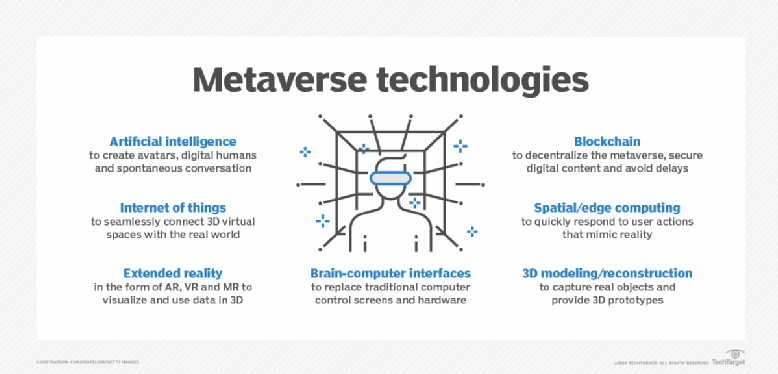
What Is the Metaverse, Really? Tech giants are ushering in the next version of the internet. But what does that even mean? ........ The next version of the internet is coming, and it’s called the metaverse. ......... an evolved, three-dimensional internet where logging in isn’t necessary. It may also incorporate elements of virtual and augmented reality. .......... The metaverse refers to an immersive and persistent three-dimensional virtual realm, shared with many users, that spans various digital platforms and merges with the physical world, where people can shop, work, play and hang out together in real time. ........... “A massively scaled and interoperable network of real-time rendered 3D virtual worlds that can be experienced synchronously and persistently by an effectively unlimited number of users with an individual sense of presence, and with continuity of data, such as identity, history, entitlements, objects, communications, and payments.” .......... Without 3D capabilities, the metaverse would just be the internet. .......... As big and diverse as the real world. ......... we are still several years away from being able to tick all the boxes required of a true metaverse. ........ Second Life proved to be a massive hit upon release, with around a million users signing up. Harvard University held classes in it, rapper Jay-Z threw a concert in it and Rolling Stone called it “the future of the Net.” Eventually, though, enthusiasm for Second Life waned, and the platform’s growth flattened. ......... Roblox, a sandbox-like virtual platform where people can build and play games and experiences, was launched in 2006 — although it took more than a decade for it to become a mainstream success. By January 2022, Roblox had nearly 55 million daily active users, and Roblox Corporation CEO David Baszucki called his company “shepherds of the metaverse.” .......... The popularity of Roblox and Fornite — along with a host of other platforms and apps like Minecraft and Snapchat — helped accelerate discussions about the imminence of the metaverse (in some tech and gaming circles, at least). But it was Facebook’s 2021 rebrand to Meta that catapulted the idea of the metaverse into the larger public consciousness. .......... Web3 is a term used to describe a decentralized internet built on a blockchain foundation. Central to Web3’s premise is that power over the internet will eventually swing away from a handful of tech giants and toward the many individual users and developers. .........

an embodied internet you are within, rather than have access to.

....... Platforms such as Fortnite, Roblox and Minecraft are not in themselves metaverses, but destinations within the metaverse. There will be lots of these sorts of destinations, not unlike individual websites on the internet today. In other words, Fortnite is not a metaverse, in the same way that Facebook is not an internet. The two are both planets within a larger galaxy. ............. Two popular examples positioning themselves at the intersection of blockchain, Web3 and the metaverse are The Sandbox and Decentraland. Both offer immersive virtual worlds, as well as tools that allow users to build monetizable projects within those worlds. And unlike many tech companies commonly associated with the metaverse, The Sandbox and Decentraland are owned by their users and built on the Ethereum blockchain. ........... requires enormous amounts of computer processing and advancements made in smartphone, gaming device and VR and AR headset technology. ......... the idea of a single metaverse is still theoretical ........ the metaverse will likely emerge with a constellation of companies, collectives and independent developers operating under some agreed-upon policies and protocols......... Fortnite is free to play, and yet the game still brought in $5.8 billion in revenue in 2021. .......... Take Roblox as an example. On the platform, users have the ability to create their own games using Roblox’s developer tools. They can then monetize their creations by selling them to other users. ......... a more exciting, imaginative successor to the internet than any science fiction novel could predict.


Meet the metaverse: Creating real value in a virtual world the next iteration of the internet, seamlessly combining our physical and digital lives. ......... In the first five months of 2022, more than $120 billion have been invested in building out metaverse technology and infrastructure. That’s more than double the $57 billion invested in all of 2021. ......... an immersive virtual environment that connects different worlds and communities. .......... It will have a lot of the components of Web3 and gaming and AR, but it will be much larger. ........... The complexity and excitement of the technology that underpins the metaverse is a whole source of renewal for innovation. ........... There are similarities to the transition to Web 2.0 in 2004 that was sparked by social networks and user-generated content. ......... billions of dollars are flowing into every corner of metaverse infrastructure to help get it there ........ We surveyed more than 3,400 consumers around the world and found two-thirds are excited about transitioning everyday activities to the metaverse, especially when it comes to connecting with people, exploring virtual worlds, and collaborating with remote colleagues. Almost 60 percent of consumers prefer at least one activity in the immersive world versus the physical alternative. More surprisingly, 79 percent of consumers active in the metaverse have made a purchase. ............ a quarter of them believe it will generate more than 15 percent of corporate revenue in the next five years. ......... it could generate up to $5 trillion in impact by 2030—about the size of Japan’s economy, the world’s third-largest. ........... the government of Seoul, which plans to spend at least $32 million on a metaverse ecosystem to improve city services, planning, administration, and support for virtual tourism. .........

Removing geographical barriers opens the doors to access in exciting new ways.

.......... The best way for business leaders to explore is by becoming metaverse users themselves.


New look at human development points way to inclusive growth broke the planet down into 40,000 microregions, a view 230 times more granular than a country perspective ........ Germany was made up of 401 microregions, and Indonesia had 502. ....... using nighttime luminosity from satellite images as a measure of activity......... whether we zoomed into the mountains of Italy, the jungles of Colombia, the outer reaches of Nigeria—there were pockets of vibrancy, growth and promise that were not visible at the country level. We changed the name of the report to Pixels of progress.” ......... “In some places, people gained more than 20 years of life expectancy over 20 years of time. In most individual countries, regions that started lower in life expectancy actually grew faster than those at the top. Rendered graphically, the catch up is visualized as a massive convergence.” ......... “This type of ‘catch-up innovation’ is just as significant as the initial scientific breakthrough,” points out Marc. “One example is the elimination or reduction of infectious diseases in Africa.” ........ two billion people achieved higher living standards. Half of them live in China alone—the second billion are spread across 75 other countries. “It’s what we call ‘China times two’” ......... we’re almost down to less than 5 percent of people living in the poorest parts in the world ..........

There may never be more children than there are now

.......... There may never be more people living in rural areas on the planet than there are now......... ‘Wow, do you have more data?’ and ‘It’s much better news than I expected,’” says Chris. “But the one that will stay with me is the client who emailed to say ‘Thanks for the presentation. I’m hopeful in a way I’ve not been in some time.’”


In a boost for the ‘metaverse,’ Roblox stock pops 25% after strong Q4 earnings for the time being, Roblox is still where the action is for today’s young gamers or “metaverse” participants if you want to call them that. (Technically, the metaverse doesn’t exist yet. It’s only a buzzword.) .......... Roblox had noted that half of its user base was 13 or older, suggesting it was successfully retaining at least some of the users that many had expected would age out of the Roblox experience. ......... Roblox may compete more directly with Meta’s Horizon Worlds by launching on Meta’s own Quest platform.

WE’VE LOST THE PLOT Our constant need for entertainment has blurred the line between fiction and reality—on television, in American politics, and in our everyday lives. ......... the trend started, as so many do, on TikTok. Amazon customers, watching packages arrive through Ring doorbell devices, asked the people making the deliveries to dance for the camera. The workers—drivers for “Earth’s most customer-centric company” and therefore highly vulnerable to customer ratings—complied. The Ring owners posted the videos. “I said bust a dance move for the camera and he did it!” ....... Dystopias often share a common feature: Amusement, in their skewed worlds, becomes a means of captivity rather than escape. George Orwell’s 1984 had the telescreen, a Ring-like device that surveilled and broadcast at the same time. The totalitarian regime of Ray Bradbury’s Fahrenheit 451 burned books, yet encouraged the watching of television. Aldous Huxley’s Brave New World described the “feelies”—movies that, embracing the tactile as well as the visual, were “far more real than reality.” In 1992, Neal Stephenson’s sci-fi novel Snow Crash imagined a form of virtual entertainment so immersive that it would allow people, essentially, to live within it. He named it the metaverse.

What Is the Metaverse? A New Reality Explained The Metaverse is a massively trending topic in today’s technology landscape. ........ XR, blockchain, and AI. ........ Blockchain is already making waves in the Metaverse as a way of investing in and supporting artists through NFTs, smart contracts, and decentralized finance. ......... Although hand, eye, and face tracking are not perfect. Developers commonly use AI to fill in the animation gaps where tracking tech fails to capture user movement. ......... Walmart and Ikea are paving the way for immersive shopping and navigation through easy-to-use mobile applications. ......... the gaming environment as the “starting point” of the Metaverse ......... around 59% of US adults identifying as gamers. ......... the medium encourages users to immerse themselves in digital worlds and join communities unrestricted by geographic location. ........ hyper-realistic renders for film, gaming, and XR productions. ....... Recently, significant companies adopted Roblox as a new and engaging advertising opportunity. NIKELAND debuted last year to motivate movement among children and increase brand awareness. ........... The gaming landscape is already home to user-generated content, virtual goods, and environments. The environment also provides an excellent landscape for developing and testing new technology, like XR mechanics, content moderation, and cryptocurrency. .......... Digital communities have existed for several years beyond the Metaverse – practically since the dawn of the internet. We’ve used everything from online forums and social media platforms to video games to connect with other human beings. Social experiences are some of the most recognizable pillars of the Metaverse .......... Following the pandemic, companies are adopting immersive tools for improving workflows between on-site and at-home employees. ........ The Metaverse also creates incredible opportunities for online learning and training in the workplace, allowing people to step into unique experiences where they can build muscle memories and new skills. ........ AR/MR Metaverse services provide an invaluable marketing route for firms. Additionally, geo-tagging technology has the power to replace billboards with easy-to-develop immersive adverts overlaid in urban environments. ......... Already, digital assets marketplaces like Opensea are collaborating with major immersive firms to unite blockchain, NFTs, and crypto into Metaverse services. ........... A central concept of the Metaverse is that the digital world should be accessible and open to everyone. No single company should have complete control over the Metaverse. We should all have a voice and equal respect in the Metaverse. .......... Like any technology, the Metaverse should have endless room to grow and develop as we learn more as a species. We’re already seeing endless new opportunities for the Metaverse emerging in developing new XR tools and NFTs. ....... A Metaverse is where users can effectively learn, build, play, communicate, and collaborate with anyone. Simultaneously, it makes the world smaller by connecting us regardless of geographical location and, more significantly, allowing more opportunities. .

Walmart Opens AR Clothing Try-On Service The retail giants adds 270,000 clothing items to its immersive retail app .......... Today, US retail giant Walmart introduced a new augmented reality (AR) smartphone service that lets customers virtually try on articles of clothing. ........ The company’s Be Your Own Model application generates real-time 3D (RT3D) digital clothing based on a topographic map created by AI and machine learning algorithms. ........ The application marks Walmart’s fifth AR update in six months, as the firm explores new ways to enhance the buyer’s journey with Web3 tools. ........ the retail giant leverages AR to enhance in-app or in-store shopping experiences. ........ The View in your Space service provides digital twins of approximately 300 products. ........ Walmart has been experimenting with Metaverse-lite solutions since 2014 when the firm released a digital shopping demo as a marketing promo ahead of SXSW 2014. .

52 Metaverse Statistics A 3D internet is coming with the metaverse, which combines our physical reality with augmented and virtual reality (AR and VR). ........ The metaverse will have social and economic systems in place, where user avatars can enjoy a wide range of immersed content. Unlike a video game, the overall experience doesn’t pause or end. One of the most notable aspects of this new virtual world is its unprecedented interoperability. Imagine purchasing a Roblox skin and then using it in Fortnite or other online games effortlessly. .......

metaverse could be the next best thing to teleportation.

......... Forbes named the metaverse one of the top ten trends everybody must be ready for in 2023. Global spending on VR/AR, the metaverse's foundation technologies, is expected to rise from $12 billion in 2020 to $72.8 billion in 2024. Because of this, leaders in industries like gaming, retail, arts, healthcare, and blockchain are determining how to position themselves as critical players in this emerging ecosystem. .......... Imagine virtually witnessing a historical event instead of reading about it, or watching a basketball game in 360-degree surround sound rather on a TV set. Attending a conference virtually and interacting with others as if they were with you will be possible, because your metaverse presence will augment your physical one. ............ promises to facilitate new forms of human connections, work, leisure, and even travel. .......... the metaverse is both a mirror of reality and a new universe, allowing the creation of an advanced reality with innovative scenarios .......... An avatar will represent you, and this online character can either mimic your physical characteristics or take on a completely different form. ......... In AR, a digital overlay projects images and graphics onto the real world. Pokรฉmon Go is an excellent example of AR where the characters are captured in real-world settings. ........ people and companies have already spent $2 billion on metaverse land! ......... designed entire concerts for fans to attend where they can interact with musicians like Ariana Grande, Travis Scott, and Marshmello. These filmed and animated concerts allow fans to navigate the game area and approach the artist's avatar in these time-shifted interactive encounters. ......... it is limitless, allowing developers to create and design entire worlds. ......... most gamers and streamers aren't all that different from their real-life friends. This implies individuals prefer online friends who are like them in real life. ........... ️The global AR, VR, and MR market will roughly reach $250 billion by 2028. ........ ️ By 2032, there will be 1.4 billion mobile AR users worldwide. ........ Metaverse’s global market value is $47.48 billion in 2022, and has a robust CAGR of 39.44%. By 2030 the value is expected to reach $678.80 billion. ......... 70% of consumers between the ages of 16 and 44 are aware of AR, despite the technology only being available for a few years now. Stats show that the adoption rate is akin to that of eCommerce. ........ Virtual art galleries now have a market worth of $2.4 billion, and are still expected to grow in 2023. With the growing popularity of NFTs and virtual reality, it's no surprise that artists are maximizing this mode of digital art format. ........ A digital Gucci bag was sold for more than $4,100, outbidding the item's actual price in real life. ....... On Roblox, 33 million people saw Lil Nas X's show. ........ 45.8 million people saw Travis Scott's Astronomical show. ........ Disney is developing a metaverse theme park. ........ ️Metaverse for marketing will continue to gain momentum. One great example is when AB InBev partnered with Zed Run to promote NFT horses, breed them, sell them, or use the unique NFTs for special events. From prices of $30, the prices now have reached $165,000. ........

️The metaverse may help people overcome disabilities (39%) and improve creativity and imagination (37%).

.......... ️In a poll of 1000 respondents, 48% said they would join the metaverse for the art and live entertainment, while 44% would participate for bitcoin and NFTs. ........

️Metaverse is slated to add $5 trillion to the global economy by 2030, given the clamor for placing marketing and events in the virtual space. eCommerce still reigns as the largest economic force ($2.6 trillion), followed by virtual learning ($270 billion), advertising ($206 billion), and gaming ($125 billion), respectively.

........ The metaverse, according to Intel, will require 1,000 times more computer power than is currently available. Economy-wise, the metaverse will soon have a significant global impact. Industry 4.0 and the metaverse ecosystem are intertwined. Exciting ways to earn money in the new economy will emerge from taking over from monotonous service jobs, which offers low-wage workers more freedom. .............

There are 400 million monthly active users dwelling on the Metaverse. The largest chunk comes from Roblox (230 million), followed by Minecraft (165 million), and Fortnite (85 million).

.

Your Next Swipe Might Be on an AI Chatbot daters who are tired: of navigating several apps at a time, optimizing their profiles, and facilitating dozens of conversations that go nowhere. ........ “I feel like it’s easier for me to be more emotionally connected to Eren than humans because I’m in control,” one user told us about her AI boyfriend. “He doesn’t try to impose his viewpoints. He asks me for my feedback.” ........ .

Whatever happened to the metaverse? Enthusiasm for a virtual future is draining away — and so is investment ......... Remember when we were all going to ditch our humdrum lives, tedious physical needs and uninspiring friends and family, so that we could live a life of virtual bliss in the metaverse? When we could give up the endless pursuit of self-improvement and just exist as perfect avatars instead? ......... It has been just one year since Meta’s fabulously dystopian Super Bowl advert for its VR headsets, in which a group of friends who have lost touch get back together in the virtual world (in the real one they were all alone, with no buddies — or lower halves).......... Type “metaverse” into Google Trends and you’ll see search traffic for the word has collapsed by about 80 per cent over the past year or so. These days, if you want to raise a load of cash, you’d be better off name-dropping “generative AI” — artificial intelligence that can “generate” text, images or other data. Venture capital investment into that particular sector jumped 425 per cent between 2020 and 2022. ........ Reality Labs, the division that makes the Meta Quest headsets, made an operating loss of $13.7bn last year. ........ Microsoft, meanwhile, has killed its “industrial metaverse team” just four months after setting it up, laying off 100 members of staff. ........ The likes of Zuckerberg appear to think it’s basically a VR world, offering the thrill of having video meetings as avatars in virtual boardrooms. ....... “That’s because you’re thinking about it the wrong way,” said Yung. “You need to think about the metaverse the same way you think about the internet. It’s not one thing. It’s everything.” ......... there have been many attempts to create such a metaverse over the last two or three decades. ........ . the biggest problem is that no matter how good the hardware gets, people basically don’t want that.” ....... we are not about to step into a suddenly formed, blockchain-powered virtual world together. The metaverse never really began — and yet it’s already over. .

The PlayStation Goggles Are a Win for Gamers. Not for the Metaverse. Sony’s new $550 headset offers best-in-class virtual reality gaming, but it’s still hard to see why we need V.R. goggles at all. ......... virtual reality still has a ways to go before becoming a staple for work and play.Credit... ........... Will a fantasy where our office meetings and social gatherings take place mostly in virtual reality ever come true? ....... As a tech critic who has worn almost every pair of virtual-reality goggles released in the last seven years, I’ve been holding my breath for a long time. And based on my testing of this year’s first big hardware release in the metaverse category — Sony’s PlayStation VR2, which arrives Wednesday — I’ve concluded that V.R. still has a ways to go before becoming a mainstream staple for work and play. ........ games are the most popular V.R. applications and productivity apps for taking video calls through headsets haven’t gained traction. ......... Why use V.R. for making video calls, streaming movies or playing games when the existing methods already work well? ........ more often than not I found myself wondering why a game should be played in V.R. instead of on a television screen. ......... Gaming may currently be V.R.’s killer app, but if you want fresh and exciting games, the console-plus-TV combo is still king. ........ all the goggles still felt too heavy. In my experience, I could wear them for no longer than 30 minutes before starting to feel neck strain. ......... And like all the goggles that came before it, the PlayStation VR2 looks pretty ridiculous. ......... In its current state, V.R. is still a mostly solitary experience. When you wear the PlayStation goggles, you block out your view of the real world. What you’re doing in the game is shown on the TV screen that the PlayStation is plugged into. That lets others in the room follow along, but it’s not very social......... To have friends to play with in the metaverse, they must buy the same headset — and the tech is still expensive. ......... maybe one day — when the tech is cheaper, has a truly killer app and doesn’t make people look like weirdos — we’ll all hang out in the metaverse. For now, I’ll continue to meet folks in person and online the old-school way. .


Why the metaverse is a becoming popular tool to teach Black history From watching Martin Luther King Jr. speak to following Black travelers on their journey along Route 66, the metaverse takes users back in time without leaving the present. ........ one of countless projects promising to bring users to a moment in time ........ What intrigues Gault the most about the metaverse is the ability to “create something you couldn’t really create in the real world,” he said. The tool also makes it practical for people to create these experiences without spending a lot of money ............ “More often than not in the African American family, our history is passed down through oral history — through talking to your aunts and your uncles, and your grandmothers and great-grandmothers around family events,” Turner said. “And we’re losing some of that. So, this is an opportunity to spur those conversations.” ......... they expect the metaverse will be a more refined, immersive, aspect of daily life for a half-billion or more people globally by 2040. .

Will the Metaverse Be Entertaining? Ask South Korea. In the world’s testing ground for tech, K-pop singers are being spun up out of pixels and doing battle in a virtual universe. ........ This, some say, is the future of entertainment in the metaverse, brought to you by South Korea, the world’s testing ground for all things technological. ........ . “Other places want to venture into the metaverse, but to be successful, you need to have good content. In Korea, that content is K-pop.” .......... Karina, a real-life member of the band Aespa, can be seen on YouTube chatting with her digital self, “ae-Karina,” in an exchange that comes off as seamlessly as late-night TV. ....... Today, Korean “virtual influencers” like Rozy and Lucy have Instagram followings in the six figures and promote very real brands, like Chevrolet and Gucci. ........ The influencers have been purposely made to look almost real, but not quite; their near-human quality is part of their appeal, said Baik Seung-yup, Rozy’s creator. ......... about 70 percent of the world’s virtual influencers are Korean. ......... The South Korean government is investing more than $170 million to support development efforts here, forming what it calls a “metaverse alliance” that includes hundreds of companies ........ “the most wired and wireless country.” ......... The show’s use of avatars lets K-pop singers be judged by their talent, not their looks ....... Mave, its artificial band in progress, as the first K-pop group created entirely within the metaverse, using machine learning, deep fake, face swap and full 3-D production technology. To give them global appeal, the company wants the “girls” of Mave to eventually be able to converse in, say, Portuguese with a Brazilian fan and Mandarin with someone in Taiwan, fluently and convincingly. ........... once such virtual beings can simulate meaningful conversations, “no real human will ever be lonely.” .


We believe in the future of connection in the metaverse .

What Is the Metaverse, Exactly? Everything you never wanted to know about the future of talking about the future. ........ TO HEAR TECH CEOs like Mark Zuckerberg or Satya Nadella talk about it, the metaverse is the future of the internet. Or it's a video game.

Or maybe it's a deeply uncomfortable, worse version of Zoom? It's hard to say.

.

What is the metaverse? An explanation and in-depth guide The metaverse is described as the inevitable evolution of the internet. But what exactly is the metaverse, and what will it become? Learn what businesses need to know now. ........ Imagine a virtual world where billions of people live, work, shop, learn and interact with each other -- all from the comfort of their couches in the physical world. .......... In this world, the computer screens we use today to connect to a worldwide web of information have become portals to a 3D virtual realm that's palpable -- like real life, only bigger and better. Digital facsimiles of ourselves, or avatars, move freely from one experience to another, taking our identities and our money with us. ......... This is known as the metaverse and, hype notwithstanding,

it does not exist today

. ....... ....... the metaverse economy could reach $5 trillion by 2030 ........ E-commerce is expected to be the dominant engine, with gaming, entertainment, education and marketing in the metaverse also becoming important sectors. ........ the current version of the metaverse is shaping up as a multiverse: a multitude of metaverses with limited interoperability as companies jockey for position. ....... the next iteration of the internet: a single, shared, immersive, persistent, 3D virtual space where humans experience life in ways they could not in the physical world. ........ The metaverse is a dynamic, open and interoperable space, much like the internet but in 3D.
.


The Metaverse in 2040 Hype? Hope? Hell? Maybe all three. Experts are split about the likely evolution of a truly immersive ‘metaverse.’ They expect that augmented- and mixed-reality enhancements will become more useful in people’s daily lives. Many worry that current online problems may be magnified if Web3 development is led by those who built today’s dominant web platforms .

Monday, December 20, 2021

December 20: Pi Phone, Metaverse, Omicron


USE SUBGOALS TO ACHIEVE YOUR MOONSHOT
Oxford Invited an AI to Debate Its Own Ethics—What It Said Was Startling
This Week’s Awesome Tech Stories From Around the Web (Through December 18)
This 'Breakthrough' in Chipmaking Could Bring Us A Phone With One-Week Battery Life Transistor stacking is getting Samsung, Intel, and IBM excited about the future of computing.
NFTs market hits $22bn as craze turns digital images into assets
Critics of non-fungible tokens say they are symptomatic of unsustainable digital gold rush
Scientists spot water ice under the 'Grand Canyon' of Mars "We found a central part of Valles Marineris to be packed full of water — far more water than we expected."
DRONE STARTUP TO FLY PALLETS WITHOUT PILOTS Dronamics will test a radical new vision of long-range cargo transport in Europe

The Metaverse Will Need 1,000x More Computing Power, Says Intel chipmaking giant Intel, the metaverse is on its way—but it’s going to take a lot more technology than we currently have to make it a reality, and the company plans to be at the forefront of the effort. .........

And what does “a persistent 3D virtual world” even mean?

....... Neal Stephenson’s book Snow Crash, published in 1992, was where the term “metaverse” first appeared; there, it described a 3D virtual world people could visit as avatars; they accessed this virtual world with virtual reality headsets that connected to a “worldwide fiber-optics network.” Another well-known reference is the 2011 book or 2018 movie Ready Player One. .......... the simplest way to describe the metaverse is as a connected network of 3D virtual worlds that is always “on” and happening alongside our real-world lives. ...... we can think of the metaverse as a “quasi-successor state to the mobile internet,” which will build on and transform the internet as we currently experience it. .........

“an even more immersive and embodied internet.”

....... powering the metaverse will require a 1,000-fold improvement on the computational infrastructure we have today ......... “You need to access to petaflops [one thousand teraflops] of computing in less than a millisecond, less than ten milliseconds for real-time uses” ....... “Your PCs, your phones, your edge networks, your cell stations that have some compute, and your cloud computing need to be kind of working in conjunction like an orchestra.” .......... “We believe that the dream of providing a petaflop of compute power and a petabyte of data within a millisecond of every human on the planet is within our reach”


Omicron Is a Dress Rehearsal for the Next Pandemic America’s response to the variant highlights both how much progress we have made over the past two years — and how much work remains. ........ Omicron is one more sign that the current pandemic, which has now claimed the lives of nearly 800,000 Americans, is not over. ...........

“We know that there are pathogens worse than SARS-CoV-2 that are emerging and re-emerging and waiting for their moment to take off”

.............. “We have this Balkanized health care system, and the system is a giant mess” ....... Just as a more equitable distribution of vaccines might help squelch the next variant of concern, preventing the next big global outbreak will require ensuring that every country has the resources to detect and respond to emerging pathogens. ........

The United States is a large and fractured country — politically polarized and burdened with glaring inequities, rampant misinformation and disinformation, and a considerable distrust of public officials.

These are enormous, thorny problems and are much harder to address than ensuring that labs have the capacity to detect Omicron or any new pathogen. ........ “I’m confident in our ability to detect the variant,” Dr. Fauver said. “What I’m not confident in is our ability to do anything about it. We’re detecting the Delta variant every single day, every time we sequence.” .......

Scientists are finding more Omicron cases every day, and the variant could soon overtake Delta.