Pages

Thursday, October 16, 2014

Going Head To Head With Carbon

Carbon dioxide
Carbon dioxide (Photo credit: Wikipedia)
ball-and-stick model of CO2: carbon dioxide
ball-and-stick model of CO2: carbon dioxide (Photo credit: Wikipedia)
Negatives emissions feel counter intuitive. Why not capture the carbon right where it is emitted? Would that not be cheaper?

Can Sucking CO2 Out of the Atmosphere Really Work?
air capture, which means, essentially, scrubbing it from the sky. ..... As emissions have accelerated—they’re now rising at 2 percent per year, twice as rapidly as they did in the last three decades of the 20th century—scientists have begun to recognize the urgency of achieving so-called “negative emissions.” ..... “Once capturing carbon from the air is profitable, people acting in their own self-interest will make it happen” ...... In the winter of 2008 Eisenberger sequestered himself in a quiet house with big glass windows overlooking the ocean in Mendocino County, California. There he studied existing literature on capturing carbon and made a key decision. ...... a 40-foot-high tower of fans, steel, and silver tubes ..“It’s doing exactly what the tree is doing,” says Eisenberger. But then he corrects himself. “Well, actually, it’s doing it a lot better.” ....... “There’s really little chance that you could capture CO2 from ambient air more cheaply than from a coal plant, where the flue gas is 300 times more concentrated” ...... deriving fuels from biomass—which removes CO2 from the atmosphere as it grows. As that feedstock is fermented in a reactor to create ethanol, it produces a stream of pure carbon dioxide that can be captured and stored underground ...... scientific advances made in air capture will eventually be used primarily on coal and gas power plants.

Monday, October 13, 2014

Extreme Orbits


That 80-20 Rule

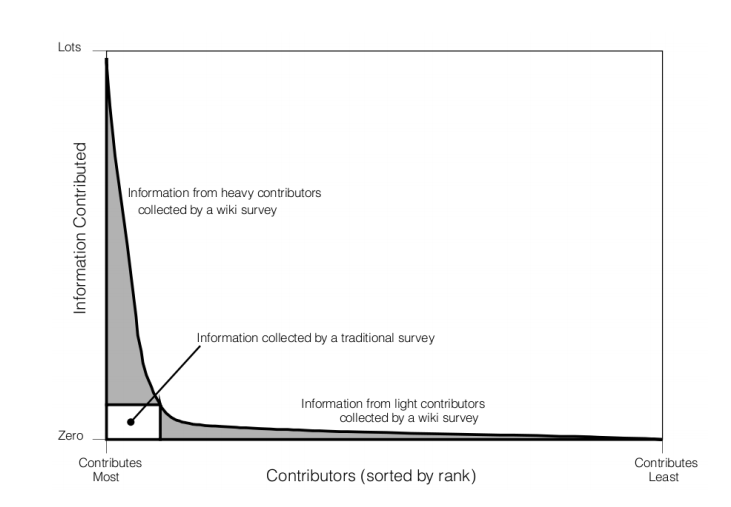
Looks like Wikipedia has its own 1%. I knew that, but this application to surveys is novel and interesting.

Inspired by Wikipedia, Social Scientists Create a Revolution in Online Surveys
Most of the information on Wikipedia comes from a tiny proportion of users. Now social scientists are collecting data in a similar way, allowing participants to design surveys as they contribute. ..... “Just as Wikipedia evolves over time based on contributions from participants, we envision an evolving survey driven by contributions from respondents” ..... a wiki survey. This starts with a set of seed questions but allows respondents to add their own questions as the survey involves. ..... this format allows participants to respond to as many choices as they wish. They call this property greediness. ...... These included ideas that would have been unlikely to emerge through other data gathering methods, such as “Keep NYC’s drinking water clean by banning fracking in NYC’s watershed” and “Plug ships into electricity grid so they don’t idle in port—reducing emissions equivalent to 12,000 cars per ship.” ...... “If Wikipedia were to allow 10 and only 10 edits per editor—akin to a survey that requires respondents to complete one and only one form—it would exclude about 95% of the edits contributed”